Why Many Cooling Neck Wraps Feel Wet or Uncomfortable
It starts in the middle of a meeting, or a grocery aisle, or a quiet moment on the couch. Heat rises from your chest to your face. Your neck goes damp. Your mind races toward one thing: cool me down, now.
So you grab the thing that promised relief. A cooling towel, an ice pack, a freezer wrap. And ten minutes later you're cold, sure, but your collar is soaked and your shirt clings to you. Now you're managing a hot flash and wet clothes. That is not relief. That is a second problem.
You're not being picky. Not all cooling products work the same way, and the difference matters. Wet towels cool by evaporation, so water is part of the deal. Ice packs are cold enough to pull moisture out of warm air, which shows up as condensation. Some freezer wraps end up dampening whatever sits against them. That's why so many of us go looking for a cooling neck wrap for hot flashes that doesn't get wet: something dry, reusable, and easy to wear.
Cooling strategies are commonly recommended for hot flashes. Think keeping your space cool, using a fan, dressing in layers, sipping cold drinks, and using a cool compress. A neck wrap fits neatly into that toolbox. It just has to be the right kind.
Use the Dry Cooling Neck Wrap Comparison Checklist
Compare any product on dryness, cooling time, recharge method, fit, and more, before you spend a cent.
Jump to the Checklist →
Quick Answer: What Type of Neck Wrap Stays Dry?
Here is the short version. PCM neck rings and sealed gel-based neck wraps are often the best starting categories if you want cooling without a wet-towel feel. Fabric-covered gel inserts may reduce direct condensation against your clothing. Evaporative towels need water, so they're not the best fit if avoiding dampness is your whole goal. And if you'd rather have nothing cold touching you at all, a neck fan gives you dry airflow.
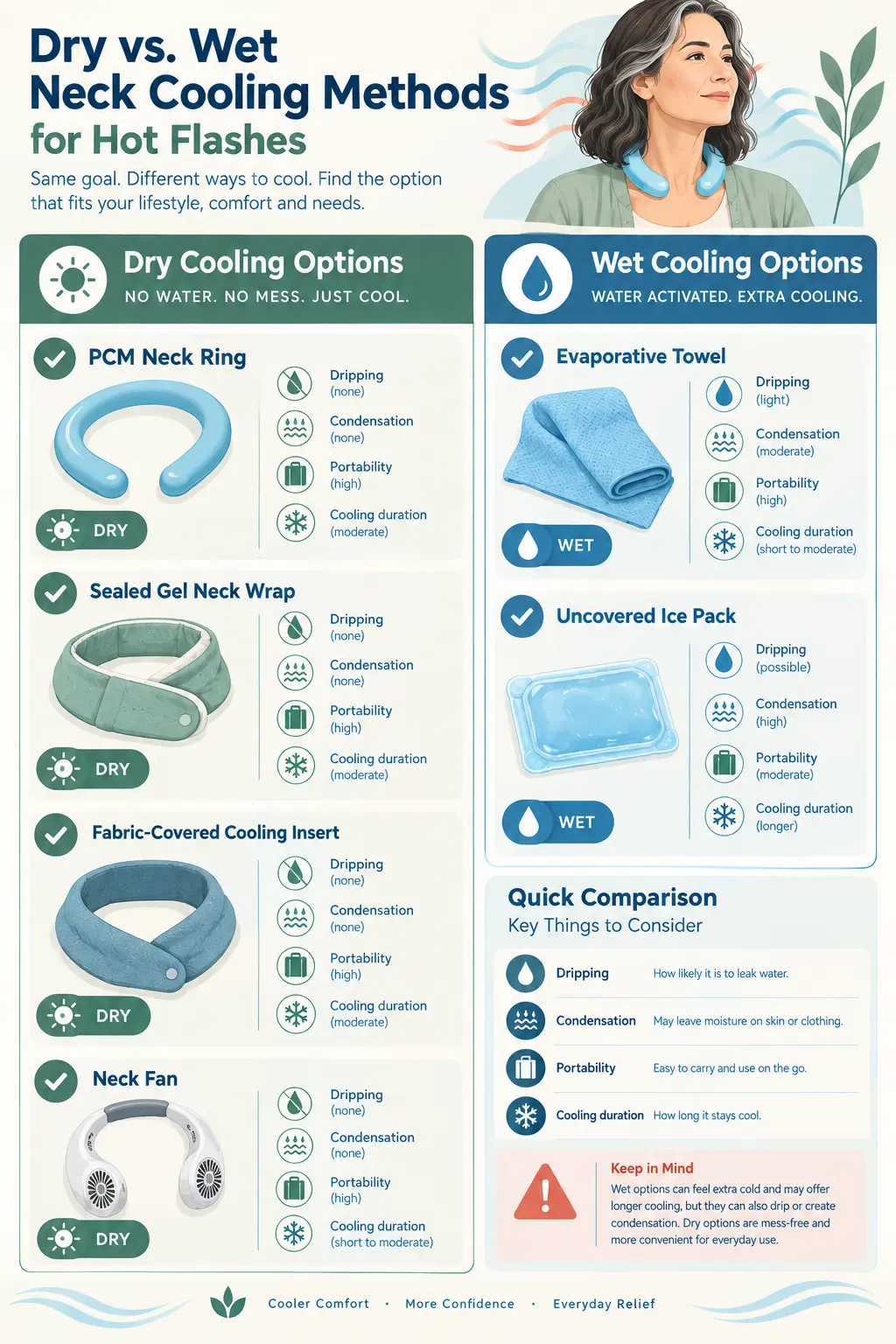
| Cooling product type | Uses water? | Can feel wet? | Best use case | Main drawback |
|---|---|---|---|---|
| PCM cooling neck ring | No | Usually low moisture risk | Desk, travel, short hot flashes | Cooling duration varies |
| Sealed gel neck wrap | No | Low to moderate condensation risk | Home, couch, bedtime | Often needs refrigeration |
| Fabric-covered ice insert | No direct water use | Lower clothing wetness than bare ice packs | Stronger cooling at home | Bulkier |
| Neck fan | No | No wetness | Work, commuting, events | Airflow may be noisy |
| Evaporative cooling towel | Yes | Often damp by design | Outdoor heat | Not ideal for “no wetness” users |
Why Some Cooling Neck Wraps Get Wet
Knowing why a product gets wet helps you skip the ones that will frustrate you.
Evaporative Cooling Towels Need Water
These towels are activated with water. As the moisture evaporates from the fabric, it carries heat away from your skin. That's the cooling. So dampness isn't a flaw. It's how the towel works. If you love the idea of a cool, damp cloth on a hot afternoon outdoors, great. If you're in a work blouse, it's likely not what you want.
Ice Packs Can Create Condensation
A very cold surface can collect moisture from warm, humid air. It's the same reason a glass of iced water “sweats.” Outdoors, or in a warm room, a cold neck ice pack can drip or leave a damp patch even though the pack itself is sealed.
Fabric Covers Can Reduce Clothing Contact
A fabric sleeve or wrap creates a buffer between a cold insert and your clothes. It can soak up a little surface moisture and soften the cold against your skin.
The Difference Between Damp, Dripping, and Dry
- Dry: No moisture on the product or your clothes. Fans are the clearest example.
- Damp: A light film of moisture, from condensation or from the product's design. Some people don't mind this. Many do.
- Dripping: Visible water running onto skin or fabric. This is the one that ruins a good outfit.
Know which one you can live with. It will narrow your choices fast.
Best Cooling Technologies for a Dry Neck Wrap
When you shop, you'll run into four main categories. Each one trades something for something else: strength of cooling, convenience, or how dry it stays.
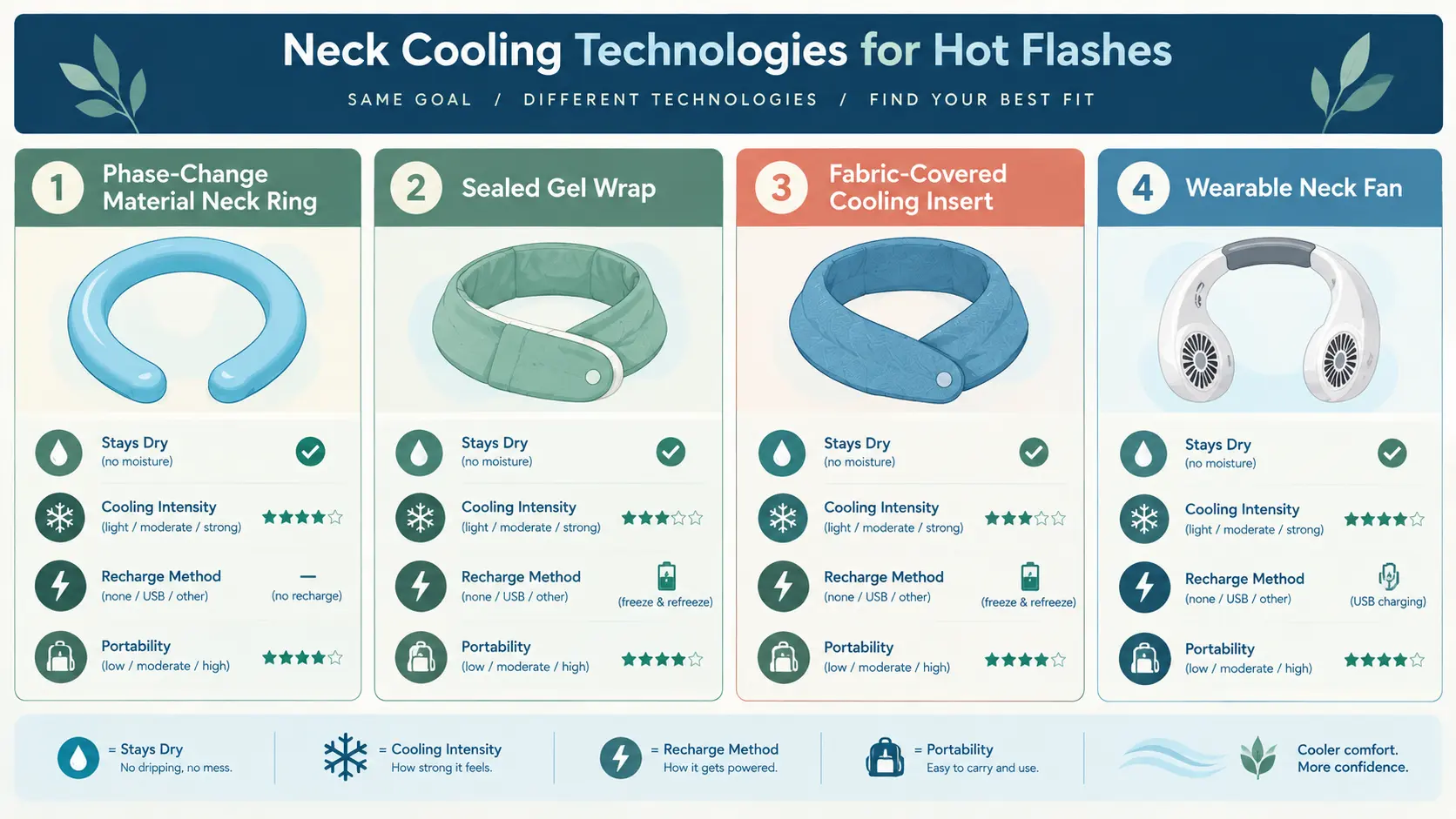
Phase-Change Material (PCM) Neck Rings
PCM products contain a material that shifts between solid and liquid at a chosen temperature. As it changes state, it absorbs heat from around your neck. They're reusable, and they're often marketed as non-dripping or low-condensation. Many are sleek enough to wear at a desk without a second glance. The trade-off: how long the cooling lasts varies from product to product, so check reviews for real-world numbers.
Sealed Gel Neck Wraps
These are flexible gel packs you chill in a refrigerator or freezer. They can feel stronger and more soothing than a PCM ring, especially at home. Because they get properly cold, condensation is more likely, so a fabric cover or thin layer is your friend. If a wrap feels too icy, the fridge often gives a gentler chill than the freezer.
Fabric-Covered Cooling Inserts
Think neck scarves, collars, and bandanas with a pocket for a cooling insert. The fabric handles the contact with your skin and clothes, while the insert does the cooling. They can look like an accessory rather than a medical-looking gadget, which many of us appreciate.
Neck Fans and Wearable Air Cooling
If cold packs and moisture both make you cringe, a wearable neck fan offers dry airflow you can direct at your skin. Nothing cold touches you, and nothing gets damp. Fans need charging or batteries, and some make noise, which matters in a quiet office.
Products to Avoid if You Hate Wetness
- Water-activated cooling towels
- Wet bandanas
- Loose ice packs with no cover
- Anything that requires soaking before use
Some water-activated towels are designed so they don't transfer moisture to your clothes. They're still damp by design, though, so they may not suit you.
How to Choose a Cooling Neck Wrap for Menopause Hot Flashes
Skip the hype and use these real-life filters.
Choose Based on Wetness Tolerance
Be honest with yourself. Do you need fully dry? Can you handle a touch of condensation you wipe away? Would a damp cloth be fine at home but not at work? Home-only use gives you more freedom than something you'll wear all day in office clothes.
Consider Cooling Duration
A hot flash may be over in minutes, or it may linger. Think about your typical day: short flashes at a desk, a long commute, hours outdoors, or a night that keeps interrupting your sleep. A ring that cools for a short stretch can be perfect for one of those and useless for another.
Check Recharge and Reuse Method
Some products go in the refrigerator or freezer. Some use cold water. Some PCM products recharge in a cool environment. Others need a USB cable. Ask yourself where you'll actually recharge it, and how you'll clean it, because a product you can't easily reset won't get used.
Prioritize Comfort and Fit
Weight, flexibility, and neck size all matter. So do skin sensitivity, long hair that gets caught, and how the product sits under a collar. A wrap that pinches or feels heavy will end up in a drawer.
Check Whether It Is Travel and Work Friendly
Look at portability, noise, leaks, charging needs, and how discreet it looks. If you can use it without explaining yourself, you're more likely to reach for it when it counts.
Cooling Neck Wraps for Different Hot Flash Situations
Instead of one “best” pick, match the tool to your moment.
Best for Hot Flashes at Work
Discreet PCM rings, quiet neck fans, and compact cooling wraps work well here. If you can, keep a backup in a desk drawer or a small cooler bag so relief is never far away.
Best for Travel and Flights
Portability is everything. Pick something that packs into a carry-on and doesn't rely on a freezer you won't have. Hot airports, packed gates, and hotel rooms with unpredictable air conditioning are exactly when a compact ring or battery fan earns its keep.
Best for Outdoor Summer Heat
Longer cooling helps, but so do the basics: shade, water, a fan, sun protection. In high humidity, cold products collect condensation faster, so a fabric cover and a spare insert are smart.
Best for Nighttime or Bedside Relief
Soft gel wraps and fabric-covered products tend to feel best when you're lying down. Skip bulky rings in bed. Pair your cooling tool with breathable bedding and light sleepwear so you're not fighting heat from every direction.
Best Low-Cost Backup Option
A small fan, a cool compress with a dry fabric cover, a spare cooling cloth, and cold water. It isn't fancy. It works.
How to Use a Cooling Neck Wrap Without Wetting Your Clothes
Use a Fabric Barrier if Needed
A thin collar, a scarf, a cotton layer, or the product's own cover can sit between the cold element and your skin or clothes. It softens the chill and catches stray moisture.
Follow the Product's Cooling Instructions
Refrigeration time, freezer time, cold-water activation, charging: every product is different, so read the instructions. And stop using anything that looks damaged or leaks.
Wipe Down Condensation Before Wearing
When you pull a wrap from the fridge or freezer, the outside may be beaded with moisture. Wipe it with a dry cloth first.
Use Short Cooling Sessions for Comfort
You don't have to keep it on for an hour.
Keep a Backup Cooling Option
A portable fan, a cold drink, layers you can peel off, and if you can swing it, a second wrap or ring to rotate.
Neck Wrap Safety for Hot Flashes
Cooling tools are comfort tools. They're not medical treatment. A few sensible habits keep them pleasant to use.
Avoid Extremely Cold Skin Contact
Very cold products against bare skin can be uncomfortable and may bother sensitive skin. Use a fabric barrier when needed, and take the wrap off if it hurts.
Consider Sensitive Skin and Allergies
Check the materials. Fragrance, fabric, plastic, gel, and latex can all cause reactions in some people. If your skin turns red, itchy, or sore, stop using the product.
Know When Hot Flashes Need Medical Discussion
Bring it up with your clinician if your hot flashes are severe, if they're new or unusual for you, if they disrupt your sleep or make daily life hard, or if you have questions about medications. You deserve real answers, not just a colder collar.
Cooling Products Manage Comfort, Not the Underlying Cause
A neck wrap may make a hot flash more bearable. It won't replace medical assessment or treatment when you need it. The Menopause Society and other major clinical sources list practical cooling techniques, including environmental cooling, light layers, cool compresses, and fans, as symptom-management tools.
Cooling Neck Wrap vs Neck Fan vs Cooling Towel
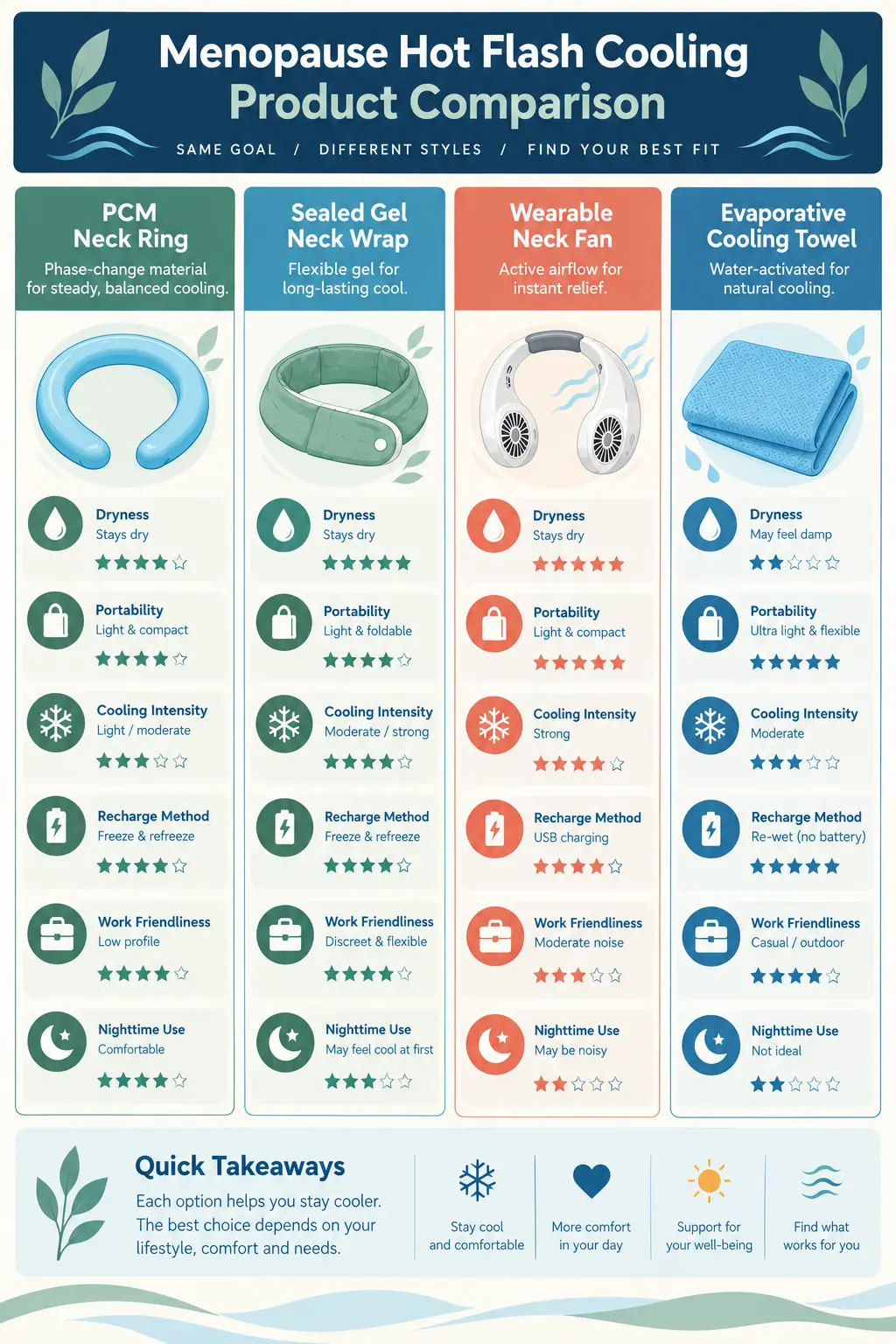
| Feature | PCM neck ring | Gel neck wrap | Neck fan | Evaporative towel |
|---|---|---|---|---|
| Stays dry | Usually | Usually with a cover | Yes | No, damp by design |
| Needs charging or cooling | Refrigerator, freezer, or cool environment | Refrigerator or freezer | USB or battery | Water activation |
| Best for | Short hot flashes, work, travel | Home or bedtime | Long workdays and commuting | Outdoor heat |
| Clothing-friendly | Usually | Better with fabric cover | Yes | Variable |
| Main drawback | Cooling duration varies | Can be bulky or form condensation | Noise or battery life | May feel wet |
Choose a PCM Neck Ring If
You want hands-free, compact, reusable cooling that feels dry and goes unnoticed at work or on the go.
Choose a Gel Wrap If
You want stronger cooling at home and you're happy to use a fabric-covered option or a thin layer between the wrap and your skin.
Choose a Neck Fan If
You don't want anything cold against your skin or clothes. Fans are the driest option of all.
Choose a Cooling Towel Only if Dampness Is Acceptable
Towels shine outdoors, during workouts, and in high heat. They're less likely to suit office clothing or anyone who wants a dry neck.
What to Look for in Product Reviews
Marketing pages promise a lot. Reviews from real people tell you what actually happens on a hot Tuesday.
Look for Comments About Condensation
Search reviews for words like damp, dripping, leaking, and humid. Does the product need a cover? How does it behave in warm rooms?
Look for Cooling-Duration Details
Real-world timing beats a claim on the box. Look for indoor versus outdoor use, how long recharging takes, and how quickly the cooling fades.
Look for Fit and Comfort Feedback
Pay attention to comments about small or large necks, weight, stiffness, hair getting caught, skin irritation, and whether it works under a collar.
Ignore “Stops Hot Flashes” Cure Claims
A cooling product can make a hot flash more comfortable. It can't treat menopause itself.
Build a Dry Hot Flash Cooling Kit
One tool rarely covers every situation. A small kit, built around where you spend your time, means you're ready wherever a hot flash finds you.
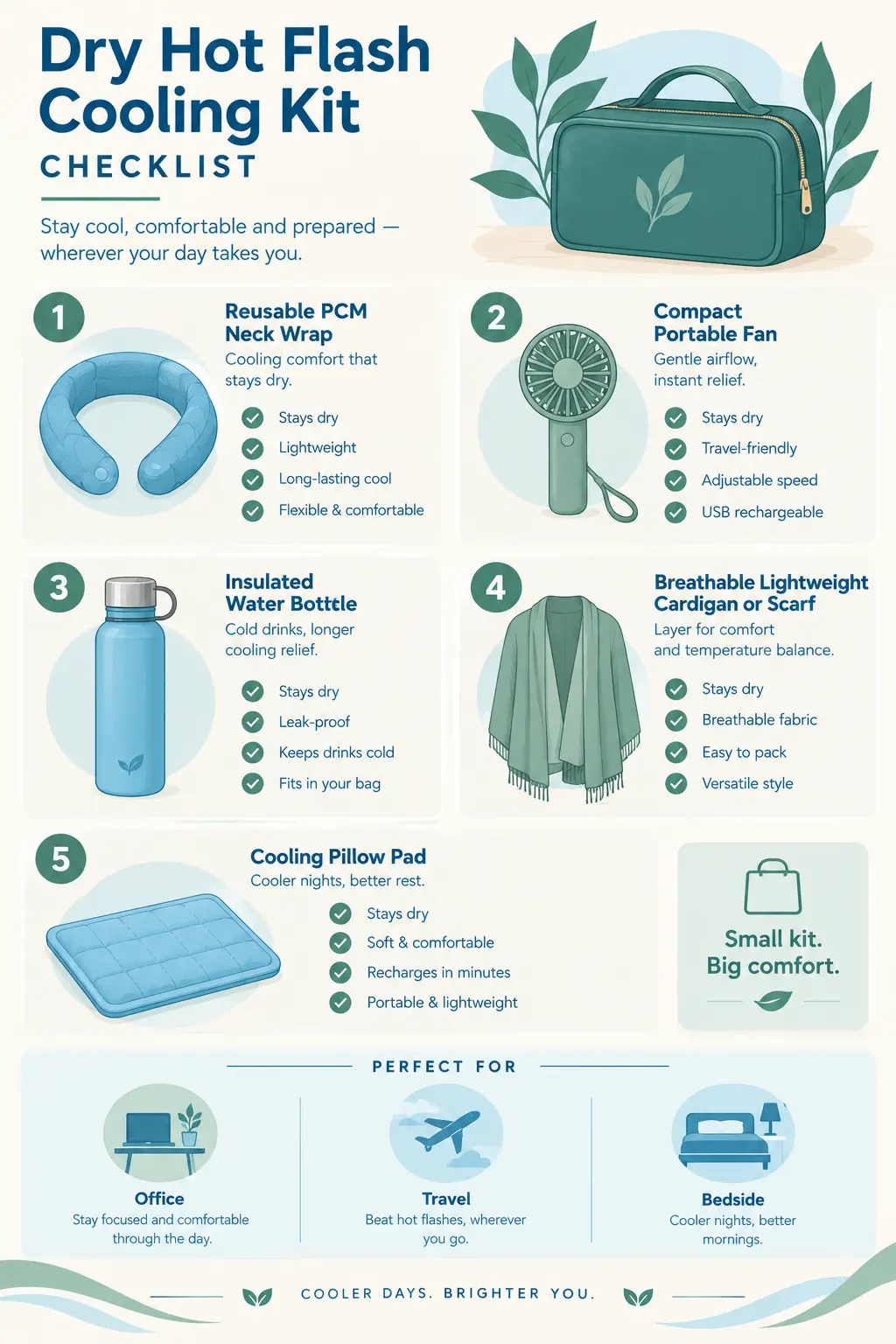
Desk or Office Cooling Kit
- PCM neck wrap
- Quiet desk fan
- Water bottle
- Breathable layer
- Cooling wipes, if you like them
- A spare top
Travel Cooling Kit
- Portable neck ring
- Battery fan
- Cooling scarf
- Hydration bottle
- Travel pouch
- Spare clothing layer
- Something cooling for hotel sleep
Bedside Cooling Kit
- Soft gel wrap
- Cooling pillow pad
- Fan
- Lightweight blanket
- Breathable sleepwear
- A symptom tracker to jot down what you notice
Budget vs Premium Bundle
A budget setup might be one wrap, a small fan, and cold water. A premium setup adds multiple cooling tools, such as a PCM ring for the day, a gel wrap for the couch, a quiet fan for the bedroom, and a cooling pillow pad.
Frequently Asked Questions
Download the Dry Cooling Neck Wrap Comparison Checklist
Print it, fill it in, and compare products side by side.
Download the Checklist → Free, printable, no strings.Final Takeaway
You shouldn't have to choose between cooling down and staying comfortable. For most of us who want cooling without wet fabric or dripping water, PCM neck rings, sealed gel wraps, fabric-covered cooling inserts, and neck fans are generally better starting points than towels or bare ice packs.
Hot flashes are one part of a much bigger transition, and it's okay to want small comforts that make ordinary days easier. Pick the tool that fits your life, keep a backup, and be gentle with yourself on the hard days.
Use the checklist, compare dry-feeling product types, and build a cooling kit around your main use case, whether that's work, travel, outdoor heat, or bedtime. And if your hot flashes are getting in the way of your life, please talk with your healthcare provider. You deserve support that goes beyond a cold neck.