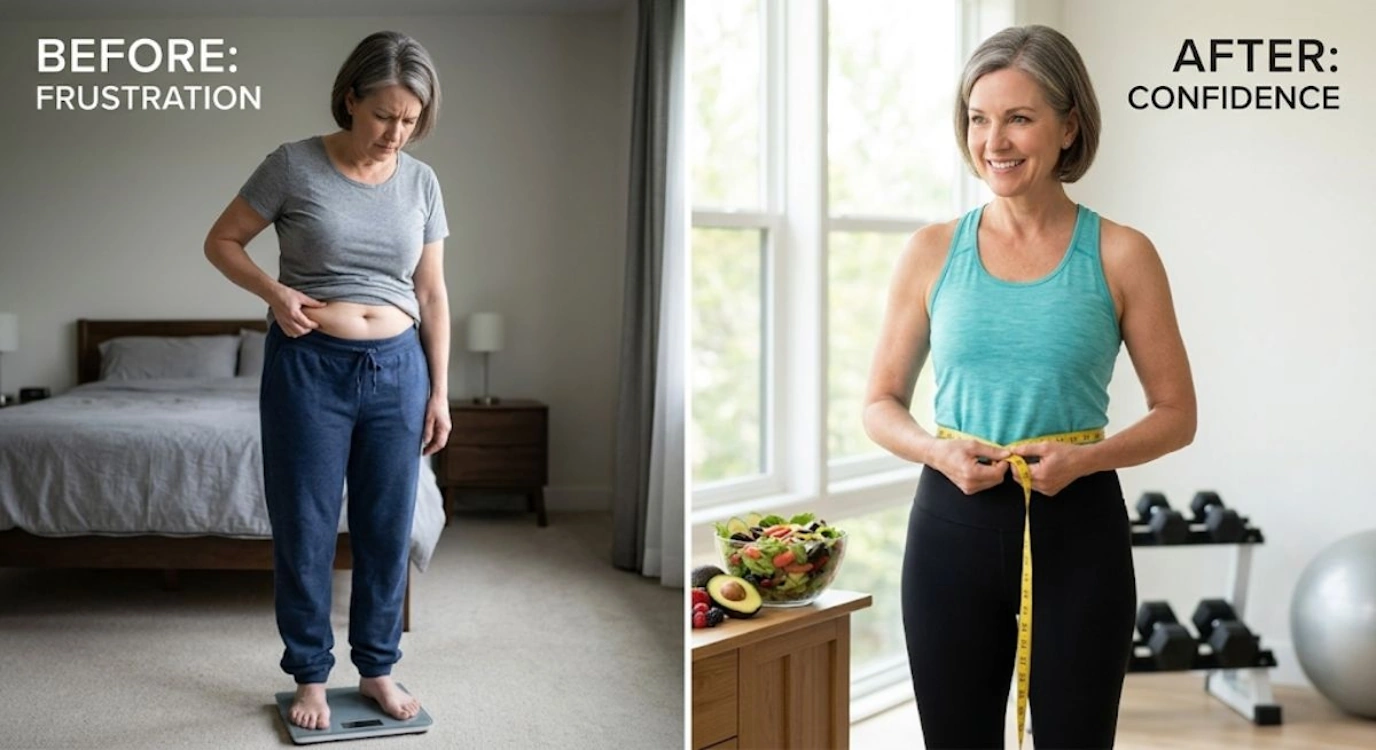
Introduction to Weight Gain in Menopause – The Statistics
If you've noticed the scale creeping up despite eating the same diet and exercising regularly, you're experiencing one of the most frustrating—and common—symptoms of menopause: unexplained weight gain.
The shocking reality:
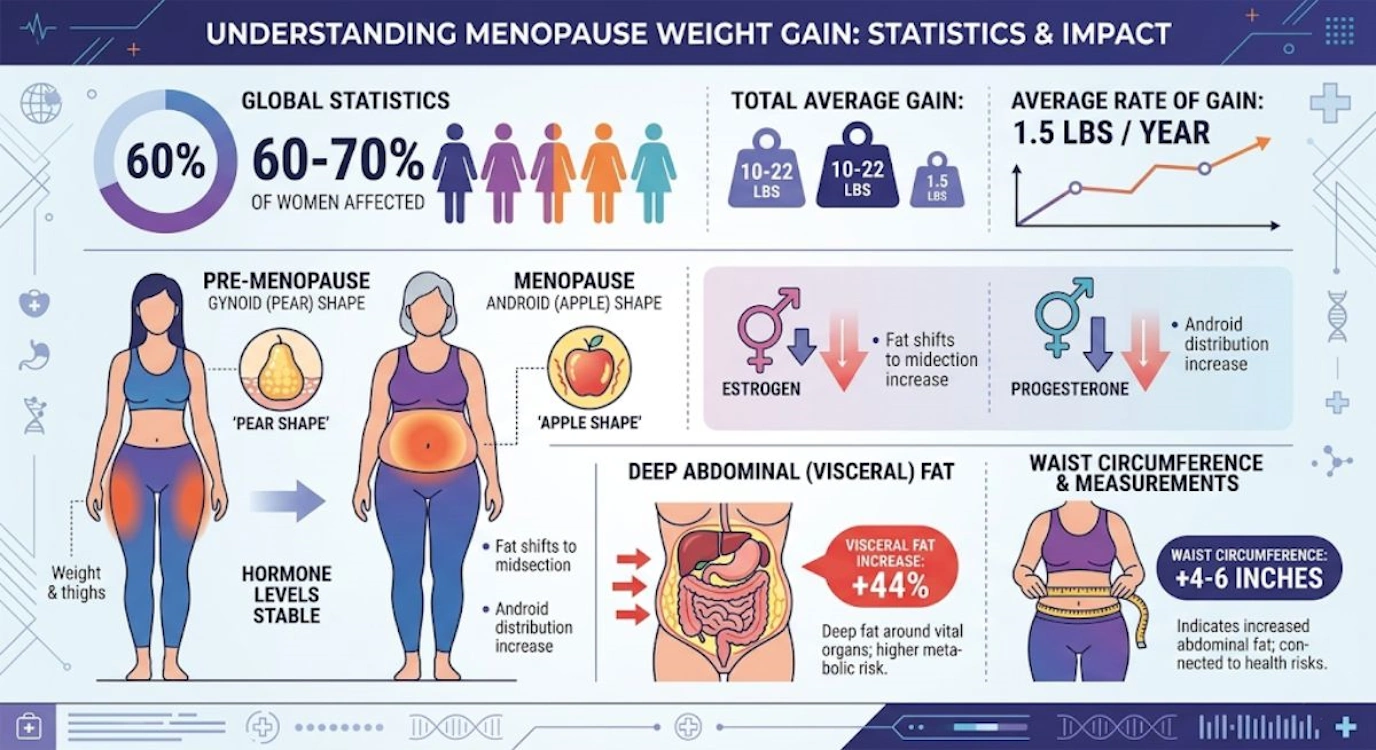
- 60-70% of menopausal women gain significant weight during the transition
- Average weight gain: 10-22 pounds over the menopausal transition (perimenopause through postmenopause)
- Weight gain rate: 1.5 pounds per year (more than pre-menopausal average of 0.5 lb/year)
- 80% of women experience body composition changes even if scale weight stays stable
- Peak gain occurs in the 3 years surrounding final menstrual period
But here's what makes menopause weight gain uniquely challenging: It's not just about the pounds—it's about where the weight goes.
The Dreaded Body Shape Shift: Pear to Apple
Before menopause (pear shape):
- Fat distributed to hips, thighs, buttocks
- Subcutaneous fat (under skin, relatively harmless)
- Hourglass or pear body shape
During/after menopause (apple shape):
- Fat redistributes to abdomen and waistline
- Visceral fat (deep abdominal fat around organs)
- Apple body shape, thicker midsection
- Waist circumference increases 4-6 inches on average
Why this matters:
Visceral abdominal fat is metabolically active and dangerous:
- Increases risk of: Heart disease, type 2 diabetes, stroke, certain cancers
- Produces inflammatory compounds
- Disrupts insulin sensitivity
- Creates vicious cycle of more weight gain
Real Transformation Stories (What's Possible)
Sarah, 52: Lost 18 pounds in 4 months
- Strategy: Strength training 3x/week + Mediterranean diet + berberine supplement
- Waist circumference: -5 inches
- Result: "I feel better than I did at 40"
Jennifer, 48 (perimenopause): Prevented gain during transition
- Strategy: Started resistance training early, high-protein diet, sleep optimization
- Weight: Stable throughout menopause (no gain)
- Result: "I stopped the weight creep before it started"
Linda, 55: Reversed postmenopausal weight gain
- Strategy: Intermittent fasting + HIIT + omega-3 supplementation
- Lost 25 pounds in 6 months
- Result: "My doctor was amazed at my metabolic improvements"
The good news? With the right strategies, menopause weight gain is preventable and reversible. This guide will show you exactly how.
Why Menopause Causes Unwanted Weight Gain (The Science)
Understanding the biological mechanisms behind menopause weight gain is crucial for effective intervention. It's not just "aging" or "slowing metabolism"—it's a complex hormonal cascade.
Hormonal Changes: Estrogen, Progesterone, and Insulin
The Estrogen Crash and Its Metabolic Consequences
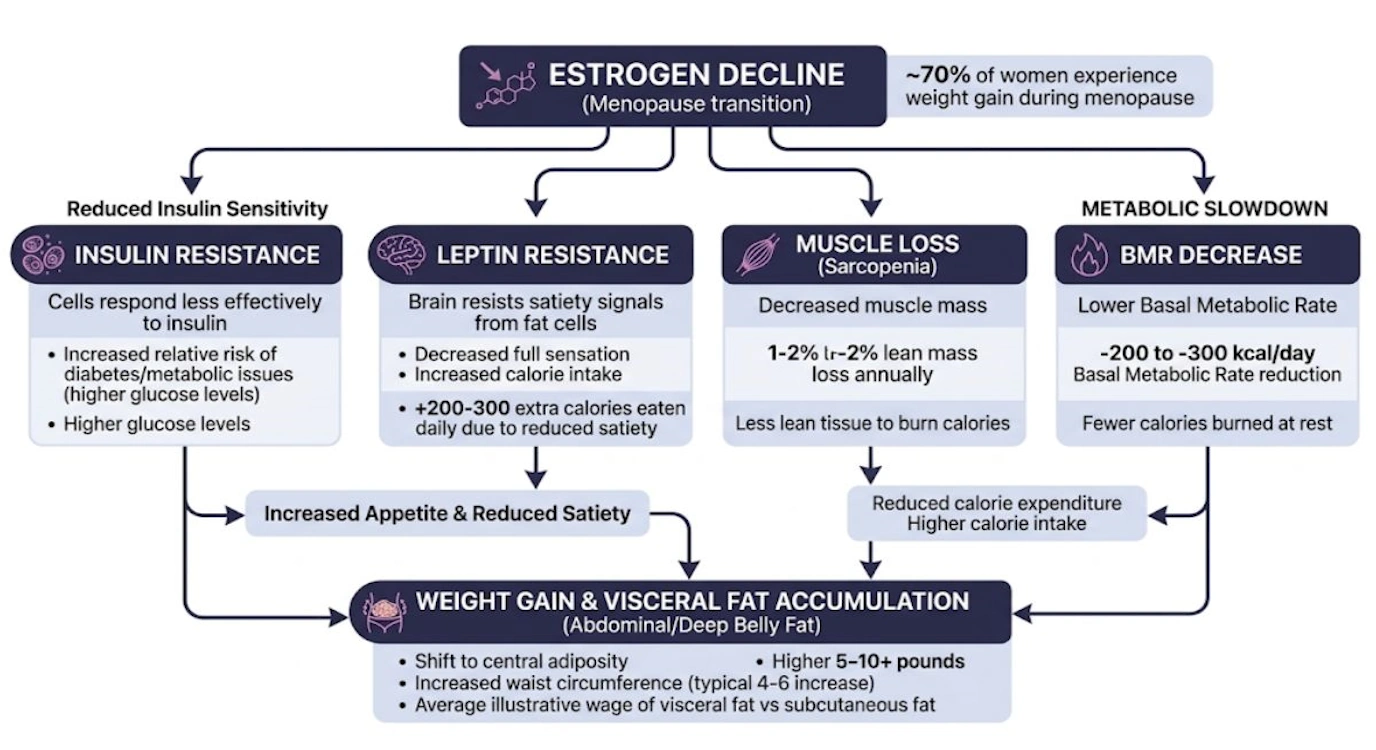
During menopause, estrogen levels drop by 60-80%. This hormonal plummet triggers multiple weight-promoting changes:
1. Insulin Resistance Development
- Estrogen normally improves insulin sensitivity (helps cells use glucose efficiently)
- Without estrogen: Cells become insulin resistant
- Result: Higher blood sugar, more glucose converted to fat storage
- 30-40% increase in insulin resistance during menopausal transition
Clinical evidence:
- 2018 Study: Postmenopausal women have 25% higher fasting insulin levels than premenopausal women of same BMI
- Insulin resistance → Weight gain → More insulin resistance (vicious cycle)
2. Leptin Sensitivity Decline
- Leptin = "satiety hormone" (tells brain you're full)
- Estrogen enhances leptin signaling
- Post-menopause: Leptin resistance develops
- Result: Increased hunger, reduced fullness signals, overeating
2020 Research:
- Menopausal women need 30% more leptin to feel same satiety as pre-menopausal women
- Explains why "I'm always hungry now" is common complaint
3. Fat Cell Distribution Reprogramming
- Estrogen receptors (ER-α) in fat cells control fat distribution
- High estrogen → Fat stored in hips/thighs (subcutaneous)
- Low estrogen → Fat stored in abdomen (visceral)
- Visceral fat increases by 44% during menopausal transition
4. Decreased Resting Metabolic Rate (RMR)
- Estrogen influences thyroid function and basal metabolism
- Post-menopause: RMR decreases 100-200 calories per day
- That's 700-1,400 fewer calories burned per week doing nothing
- Annual impact: Potential 10-20 lb weight gain if diet unchanged
Progesterone's Role
While less discussed, progesterone decline also contributes:
1. Water Retention and Bloating
- Progesterone has mild diuretic effect
- Loss → Increased water retention, bloating
- Can add 3-5 pounds of "scale weight" (not fat, but frustrating)
2. Mood and Sleep Disruption
- Progesterone has calming, GABA-like effects
- Loss → Anxiety, poor sleep
- Poor sleep → Weight gain (see section below)
Insulin and Blood Sugar Dysregulation
The estrogen-insulin connection creates a perfect storm:
Pre-menopause:
Post-menopause:
2021 Clinical Study:
- Postmenopausal women with insulin resistance gained 2.5x more weight over 3 years than those with good insulin sensitivity
- Fasting insulin >10 μIU/mL = high risk for menopause weight gain
Key takeaway: Improving insulin sensitivity is critical for preventing/reversing menopause weight gain
Metabolic Slowdown and Muscle Loss After 40
The Muscle-Metabolism Connection
Sarcopenia (muscle loss) accelerates during menopause:
Natural muscle loss timeline:
- Ages 30-50: Lose 3-8% muscle mass per decade
- Ages 50+: Lose 5-10% per decade (accelerates)
- Menopause accelerates sarcopenia by an additional 10-15%
Why this causes weight gain:
- Muscle is metabolically active (burns 6 calories per pound per day at rest)
- Fat burns only 2 calories per pound per day
- Losing 5 pounds of muscle = 30 fewer calories burned daily = 3 lb fat gain per year
Compounding effect:
Year 1 (age 50):
- Lose 2 lb muscle → Metabolism drops 12 cal/day → Gain 1.3 lb fat
Year 5 (age 55):
- Lost total 10 lb muscle → Metabolism drops 60 cal/day → Gained 6.5 lb fat
- Plus estrogen-driven metabolic slowdown (100-200 cal/day)
- Total deficit: 160-260 cal/day = 16-27 lb potential gain
Additional Metabolic Factors
1. Thyroid Function Decline
- Hypothyroidism risk increases with age and menopause
- 10% of postmenopausal women develop subclinical hypothyroidism
- Symptoms: Fatigue, cold intolerance, weight gain
2. Growth Hormone Reduction
- Growth hormone (GH) supports muscle maintenance and fat burning
- GH production decreases 14% per decade after 40
- Lower GH → Easier fat gain, harder muscle retention
3. Cortisol Dysregulation
- Chronic stress (common during menopause transition) elevates cortisol
- High cortisol → Abdominal fat storage, muscle breakdown
- Sleep disruption (night sweats) → More cortisol → More belly fat
The Perfect Storm Timeline
Perimenopause begins (ages 40-48):
- Estrogen fluctuations start
- Muscle loss accelerates
- Metabolism begins slowing
Menopause transition (ages 48-52):
- Estrogen crash intensifies
- Insulin resistance peaks
- Maximum weight gain rate (2-3 lb/year)
Postmenopause (52+):
- Low estrogen state continues
- Ongoing muscle loss if no intervention
- Weight stabilizes but at higher level
Critical window: The 3-year period surrounding final menstrual period accounts for most weight gain. Early intervention is key.
Where Menopause Weight Gain Shows Up Most (Body Composition Shifts)
The Visceral Fat Explosion
The most dangerous aspect of menopause weight gain isn't the total pounds—it's the fat redistribution to the abdomen.
Clinical measurements:
Visceral fat changes:
- Pre-menopause: Average visceral fat area = 70-90 cm²
- Post-menopause: Average visceral fat area = 100-130 cm² (44% increase)
Waist circumference:
- Average increase: 4-6 inches during menopausal transition
- Even women who maintain stable weight see waist expansion
Hip/thigh fat:
- Decreases 10-15% (subcutaneous fat loss)
- Pants fit differently (tighter waist, looser hips)
Why Visceral Fat is So Dangerous
Unlike subcutaneous fat (under skin), visceral fat:
- Produces inflammatory cytokines (IL-6, TNF-α)
- Releases free fatty acids directly into bloodstream → Insulin resistance
- Increases cardiovascular disease risk by 60%
- Doubles type 2 diabetes risk
- Increases cancer risk (breast, colon, endometrial)
Metabolic syndrome criteria:
Women with waist circumference >35 inches have significantly higher risk of:
- High blood pressure
- High triglycerides
- Low HDL cholesterol
- Elevated blood sugar
- All components of metabolic syndrome
The "Skinny Fat" Phenomenon
Some menopausal women experience sarcopenic obesity:
- Scale weight may be normal or even decrease
- But: Lost muscle mass, gained fat mass
- Higher body fat percentage despite stable weight
- Result: Weaker, softer, higher disease risk
- 35% of "normal weight" postmenopausal women had excess body fat (>30%)
- Increased risk of metabolic disease despite BMI <25
Why it happens:
- Muscle weighs more than fat
- Losing 5 lb muscle + gaining 5 lb fat = Same scale weight but worse body composition
Key metric: Body composition matters more than scale weight during menopause
Bone Density Loss Compounds Appearance
Menopause doesn't just cause fat gain—it also causes bone loss:
- 10-20% bone density loss in first 5 years post-menopause
- Leads to: Height loss (1-2 inches), stooped posture, "dowager's hump"
- Compounds appearance of weight gain and belly protrusion
Combined effect:
- Lost muscle (less toned appearance)
- Gained visceral fat (protruding belly)
- Lost bone density (shorter stature, poor posture)
- Result: Dramatically changed body shape
7 Proven Strategies to Prevent Menopause Weight Gain
The good news? Menopause weight gain is NOT inevitable. Research shows these 7 strategies can prevent or reverse weight gain effectively.
#1: Strength Training 3x/Week (Preserves Muscle Mass)
Why resistance training is NON-NEGOTIABLE during menopause:
The muscle preservation equation:
- Lose 5-10% muscle per decade after 50 (if sedentary)
- Strength training preserves 90-100% of muscle mass
- Every pound of muscle = 6 calories burned daily at rest
- Maintain muscle = Maintain metabolism
Clinical evidence:
2018 Study (160 postmenopausal women, 12 months):
- Group A: Strength training 3x/week (60 min sessions)
- Group B: No exercise
- Results:
- Group A: LOST 5 lb fat, GAINED 3 lb muscle (8 lb body composition improvement)
- Group B: Gained 7 lb fat, lost 2 lb muscle
- Difference: 15 lb body composition swing
- Resistance training in postmenopausal women:
- Reduced body fat by 2-4%
- Increased lean mass by 2-3 lb
- Improved insulin sensitivity by 25%
Compound Lifts: Maximum Bang for Your Buck
Best exercises (prioritize these):
1. Squats (Barbell or Goblet)
- Works: Quads, glutes, hamstrings, core
- Burns most calories
- Builds functional strength
- Start: Bodyweight or light weights, perfect form first
2. Deadlifts (Conventional or Romanian)
- Works: Entire posterior chain (back, glutes, hamstrings)
- Excellent for posture (combats menopause stooping)
- Builds bone density in spine and hips
3. Push Exercises (Push-ups, Chest Press, Overhead Press)
- Works: Chest, shoulders, triceps
- Prevents upper body weakness
4. Pull Exercises (Rows, Pull-downs, Pull-ups)
- Works: Back, biceps
- Improves posture, prevents "hunching"
5. Lunges and Step-Ups
- Works: Legs, glutes, balance
- Functional movement patterns
Sample 3x/Week Split:
Monday (Lower Body Focus):
- Squats: 3 sets x 8-12 reps
- Romanian Deadlifts: 3 sets x 10 reps
- Lunges: 3 sets x 12 reps each leg
- Calf Raises: 3 sets x 15 reps
Wednesday (Upper Body Focus):
- Chest Press: 3 sets x 10 reps
- Bent-Over Rows: 3 sets x 10 reps
- Shoulder Press: 3 sets x 12 reps
- Bicep Curls + Tricep Extensions: 2 sets each
Friday (Full Body):
- Deadlifts: 3 sets x 6-8 reps
- Push-ups: 3 sets x max reps
- Lat Pull-downs: 3 sets x 12 reps
- Planks: 3 sets x 30-60 sec
Progression: Increase weight by 2.5-5 lb when you can complete all reps with good form
HIIT vs Steady Cardio for Menopause
HIIT (High-Intensity Interval Training):
- ✓ Burns more calories in less time
- ✓ Increases metabolic rate for 24-48 hours post-workout (EPOC effect)
- ✓ Preserves muscle better than steady cardio
- ✓ Improves insulin sensitivity
- ✗ Higher impact (may be hard on joints)
Steady-State Cardio:
- ✓ Lower impact (walking, swimming, cycling)
- ✓ Easier recovery
- ✓ Better for beginners
- ✗ Burns fewer calories
- ✗ Less metabolic benefit
Recommendation:
- Primary: Strength training 3x/week (most important)
- Secondary: 2x HIIT or 3-4x moderate cardio (20-30 min)
- Daily: 7,000-10,000 steps (general activity)
#2: Protein-First Diet (1.6g/kg Bodyweight)
Why protein requirements INCREASE during menopause:
Pre-menopause protein needs: 0.8-1.0g per kg bodyweight
Menopause protein needs: 1.6-2.0g per kg bodyweight
Why the increase?
- Muscle protein synthesis becomes less efficient (need more protein for same muscle maintenance)
- Higher protein boosts satiety (combats leptin resistance)
- Thermic effect of protein (burns 25-30% of calories during digestion vs 5-10% for carbs/fat)
Clinical evidence:
2019 Study (100 postmenopausal women, 6 months):
- High-protein group: 1.6g/kg daily (25-30% of calories)
- Standard-protein group: 0.8g/kg daily (15% of calories)
- Both groups: Same total calories (1,500/day)
- Results:
- High-protein: Lost 12 lb, preserved muscle mass
- Standard-protein: Lost 7 lb, lost muscle mass
- High-protein group: Better satiety, less hunger
Best Protein Sources for Menopause Hormones
Animal Proteins (Complete amino acids):
1. Eggs (especially yolks)
- Contain choline (supports liver estrogen metabolism)
- High-quality protein (6g per egg)
- Vitamin D (bone health)
2. Wild-Caught Salmon
- Protein + omega-3s (anti-inflammatory)
- Vitamin D
- Target: 2-3 servings weekly
3. Greek Yogurt (Unsweetened)
- 15-20g protein per cup
- Probiotics (gut health affects weight)
- Calcium (bone health)
4. Lean Poultry (Chicken, Turkey)
- High protein, low fat
- Versatile, affordable
5. Grass-Fed Beef (Moderate Amounts)
- Rich in iron, B12, zinc
- CLA (conjugated linoleic acid) may support fat loss
- 1-2x weekly
Plant Proteins (Hormone-Friendly):
1. Organic Soy (Tofu, Tempeh, Edamame)
- Complete protein
- Phytoestrogens (isoflavones) may ease menopause symptoms
- Caution: Avoid if history of estrogen-sensitive cancers (discuss with doctor)
2. Lentils and Beans
- Protein + fiber (blood sugar control)
- Affordable, versatile
3. Quinoa
- Complete protein
- Complex carb (sustained energy)
4. Hemp Seeds/Hearts
- Protein + omega-3s
- Add to smoothies, salads
Daily Protein Target Calculator:
Example: 150 lb (68 kg) woman
- Target: 68 kg x 1.6g = 109g protein daily
Sample breakdown:
- Breakfast: 3-egg omelet with vegetables (18g)
- Snack: Greek yogurt (20g)
- Lunch: Chicken breast salad (35g)
- Snack: Protein shake or almonds (20g)
- Dinner: Salmon with vegetables (30g)
- Total: 123g protein
Protein timing: Distribute evenly across meals (20-30g per meal) for optimal muscle protein synthesis
#3: Calorie Deficit (But Not Too Extreme)
The menopause calorie equation:
Pre-menopause maintenance: ~2,000 calories/day (average)
Post-menopause maintenance: ~1,700-1,800 calories/day (due to slower metabolism)
For weight loss:
- Safe deficit: 300-500 calories below maintenance
- Target range: 1,400-1,600 calories daily (for most women)
- NOT recommended: <1,200 calories (slows metabolism further, loses muscle)
#4: Prioritize Sleep (7-9 Hours)
The sleep-weight connection in menopause:
Poor sleep (<6 hours) causes:
- 30% higher risk of weight gain during menopause
- Increased ghrelin (hunger hormone) by 15%
- Decreased leptin (fullness hormone) by 15%
- Elevated cortisol → Belly fat storage
- Impaired insulin sensitivity
2017 Study (600 menopausal women, 3 years):
- Women sleeping <6 hours: Gained average 8.5 lb
- Women sleeping 7-9 hours: Gained average 2.3 lb
- Sleep was stronger predictor than diet or exercise
Sleep optimization strategies:
- Cool bedroom (60-67°F helps hot flashes too)
- Consistent sleep schedule
- No screens 1 hour before bed
- Magnesium glycinate 400mg before bed
- Consider melatonin 3-5mg if insomnia
#5: Manage Stress and Cortisol
Chronic stress → Cortisol → Belly fat:
2016 Research:
- Women with high perceived stress gained 3x more visceral fat over 3 years
- Cortisol directly promotes abdominal fat storage
- Stress eating compounds problem
Cortisol-lowering strategies:
Ashwagandha (KSM-66): 300mg twice daily
- Evidence: Reduces cortisol by 27-30%
- Improves stress resilience
- May support weight loss (secondary effect)
Other stress management:
- Meditation (10-20 min daily)
- Yoga or tai chi
- Deep breathing exercises
- Nature walks
- Therapy or counseling if needed
#6: Intermittent Fasting (16:8 or 14:10)
Time-restricted eating for menopause:
2020 Study (135 postmenopausal women, 12 weeks):
- 16:8 fasting: Eat within 8-hour window (e.g., 12pm-8pm)
- Control: Regular eating
- Results:
- Fasting group: Lost 7.2 lb vs 2.1 lb control
- Improved insulin sensitivity by 35%
- Better adherence than continuous calorie restriction
Why it works for menopause:
- Improves insulin sensitivity (combats menopause insulin resistance)
- Easier adherence (no calorie counting needed)
- Autophagy benefits (cellular cleanup)
Caution: Not for everyone (may worsen sleep if eating window too late)
#7: Reduce Processed Carbs and Sugar
Insulin resistance + processed carbs = Maximum weight gain
Carb sources to minimize:
- White bread, pasta, rice
- Sugary snacks, desserts
- Fruit juice, soda
- Processed cereals
Better carb choices:
- Vegetables (unlimited)
- Berries (antioxidants, low sugar)
- Sweet potatoes, quinoa (moderate portions)
- Beans, lentils (protein + fiber)
Target: <100-150g carbs daily for weight loss (adjust based on activity)
Best Diet Plans for Menopause Weight Loss
Evidence-based approaches ranked:
Mediterranean Diet (30% Better Results)
Why it's #1 for menopause:
- Postmenopausal women on Mediterranean diet lost 30% more weight than low-fat diet
- Reduced visceral fat significantly
- Improved cardiovascular markers
- Better adherence long-term
Core principles:
- Healthy fats: Olive oil, nuts, fatty fish (omega-3s)
- Lean proteins: Fish, poultry, legumes
- Abundant vegetables and fruits
- Whole grains (moderate)
- Limited red meat and processed foods
- Moderate red wine (optional, 1 glass daily)
Why it works for menopause:
- Anti-inflammatory (reduces visceral fat inflammation)
- Supports heart health (risk increases post-menopause)
- Phytoestrogens from plants
- Sustainable long-term
Low-Carb/Keto (Rapid Results, Harder Sustainability)
2018 Study (89 postmenopausal women, 6 months):
- Low-carb (<50g/day): Lost average 14 lb
- Standard diet: Lost average 6 lb
- But: 40% dropout rate in low-carb group (difficult to maintain)
Pros:
- Rapid initial weight loss
- Excellent for insulin resistance
- Reduces hunger (ketosis effect)
Cons:
- Harder to sustain long-term
- May worsen constipation (common in menopause)
- Requires careful planning
Recommendation: Consider modified low-carb (75-100g daily) rather than strict keto for better sustainability
Intermittent Fasting (IF) - 16:8 or 14:10
Already covered above - 16:8 window effective for menopause
Alternative: 14:10 (easier for beginners)
- Eating window: 10 hours (e.g., 8am-6pm)
- Fasting: 14 hours (including sleep)
- Still provides benefits, easier adherence
Sample 1,600 Calorie Menopause Meal Plan
Macronutrient breakdown:
- Protein: 120g (30%)
- Fat: 60g (34%)
- Carbs: 140g (36%)
Daily structure:
Breakfast (400 calories):
- 3-egg vegetable omelet with spinach, tomatoes, mushrooms
- 1 slice whole grain toast with 1 tsp butter
- 1/2 cup berries
Snack (150 calories):
- Greek yogurt (plain, unsweetened) with cinnamon
Lunch (450 calories):
- Grilled chicken breast (5 oz)
- Large mixed green salad with olive oil dressing
- Quinoa (1/2 cup cooked)
Snack (200 calories):
- Apple slices with 2 tbsp almond butter
Dinner (400 calories):
- Baked salmon (5 oz)
- Roasted vegetables (broccoli, Brussels sprouts, carrots)
- Small sweet potato
Total: ~1,600 calories, 120g protein
7-Day Menopause Weight Loss Meal Plan (1,500-1,800 Calories)
Day 1:
- Breakfast: Protein smoothie (protein powder, spinach, berries, almond milk, chia seeds)
- Lunch: Turkey and avocado lettuce wraps, side salad
- Dinner: Grilled chicken with roasted vegetables, quinoa
- Snacks: Greek yogurt, mixed nuts
Day 2:
- Breakfast: Scrambled eggs with smoked salmon and asparagus
- Lunch: Mediterranean chickpea salad with feta, olives, cucumber
- Dinner: Baked cod with lemon, steamed broccoli, brown rice
- Snacks: Apple with almond butter, veggie sticks with hummus
Day 3:
- Breakfast: Overnight oats with protein powder, walnuts, blueberries
- Lunch: Grilled chicken Caesar salad (light dressing)
- Dinner: Lean beef stir-fry with mixed vegetables, cauliflower rice
- Snacks: Hard-boiled eggs, dark chocolate (85%+)
Day 4:
- Breakfast: Vegetable frittata with side of avocado
- Lunch: Lentil soup with mixed green salad
- Dinner: Grilled shrimp with zucchini noodles and pesto
- Snacks: Cottage cheese with cucumber, handful of almonds
Day 5:
- Breakfast: Greek yogurt parfait with nuts, seeds, berries
- Lunch: Turkey burger (no bun) with sweet potato fries (oven-baked)
- Dinner: Baked salmon with asparagus and wild rice
- Snacks: Protein shake, celery with almond butter
Day 6:
- Breakfast: Smoked salmon and cream cheese on whole grain toast, side salad
- Lunch: Chicken and vegetable soup, side of quinoa
- Dinner: Grass-fed beef with roasted Brussels sprouts and butternut squash
- Snacks: String cheese, berries
Day 7:
- Breakfast: Spinach and mushroom omelet with avocado
- Lunch: Tuna salad (olive oil based) on mixed greens
- Dinner: Chicken breast with ratatouille and farro
- Snacks: Greek yogurt with cinnamon, mixed nuts
Meal prep tips:
- Cook proteins in batch (Sunday)
- Pre-chop vegetables
- Hard-boil eggs for quick snacks
- Make overnight oats 3-4 days ahead
Top Supplements to Fight Menopause Weight Gain
While diet and exercise are foundational, certain evidence-based supplements can enhance fat loss and improve metabolic function during menopause.
Evidence-Based Supplements for Menopause Weight Management
Berberine (500mg, 3x daily before meals):
- Gold standard for insulin resistance
- 2019 Meta-Analysis: Reduces body weight, BMI, waist circumference
- Comparable to metformin for blood sugar control
- Start: 500mg before each meal, work up to 1,500mg total daily
Omega-3 Fish Oil (2g EPA+DHA daily):
- Reduces inflammation
- Improves insulin sensitivity
- May reduce visceral fat accumulation
- Choose high-quality, third-party tested
Inulin Prebiotic Fiber (10-15g daily):
- Feeds beneficial gut bacteria
- Improves satiety
- May reduce calorie absorption
- Supports insulin sensitivity
DIM (Diindolylmethane, 200mg daily):
- Supports healthy estrogen metabolism
- May reduce estrogen dominance
- Found in cruciferous vegetables (broccoli, cauliflower)
Vitamin D3 (2,000-4,000 IU daily):
- 70% of menopausal women deficient
- Deficiency linked to weight gain
- Supports bone health simultaneously
Supplement Stacking Protocol
Morning:
- Berberine 500mg (if using)
- Vitamin D3 2,000-4,000 IU
- Omega-3 1,000mg
Before lunch:
- Berberine 500mg (if using)
Before dinner:
- Berberine 500mg (if using)
- Omega-3 1,000mg
Evening:
- Magnesium glycinate 400mg (sleep + muscle relaxation)
Throughout day:
- Green tea or herbal tea
- Inulin fiber mixed in water
Important: Start supplements one at a time, assess tolerance, then stack
Hormonal Testing and Medical Options for Stubborn Gain
When diet and exercise aren't enough:
Essential Testing
1. DEXA Scan (Body Composition)
- Measures exact fat vs muscle mass
- Tracks visceral fat specifically
- Baseline + Follow-up (every 6 months) shows true progress
- More accurate than scale weight
2. Comprehensive Hormone Panel:
- Estradiol (estrogen level)
- Progesterone
- Testosterone (supports muscle, metabolism)
- TSH, Free T3, Free T4 (thyroid function)
- Fasting insulin (insulin resistance marker)
- Hemoglobin A1C (3-month blood sugar average)
- Cortisol (stress hormone)
3. Metabolic Panel:
- Fasting glucose
- Lipid panel (cholesterol, triglycerides)
- Liver function
- Kidney function
When to test:
- Baseline: Early perimenopause or if gaining weight
- Follow-up: Every 6-12 months
- Adjust interventions based on results
Medical Weight Loss Options
GLP-1 Agonists (Semaglutide, Tirzepatide):
2023 Clinical Evidence:
- Semaglutide (Wegovy) in postmenopausal women:
- Average weight loss: 15-20% of body weight over 68 weeks
- Reduced visceral fat significantly
- Improved metabolic markers
How they work:
- Mimic GLP-1 (satiety hormone)
- Reduce appetite dramatically
- Slow gastric emptying
Pros:
- Highly effective for significant weight loss
- Improves insulin sensitivity
- FDA-approved
Cons:
- Expensive ($1,000+ monthly without insurance)
- Requires injection
- Side effects: Nausea, GI issues
- Weight regain common after stopping
Recommendation: Consider if BMI >30 or >27 with comorbidities, after lifestyle interventions
Hormone Replacement Therapy (HRT) and Weight:
Does HRT prevent weight gain?
Research consensus:
- HRT does NOT significantly prevent total weight gain
- BUT: May reduce visceral fat accumulation
- Helps preserve muscle mass
- Improves insulin sensitivity
- Women on HRT gained similar total weight as non-HRT
- However: Body composition better (less visceral fat, more muscle)
- Waist circumference smaller
HRT benefits for weight:
- Easier to lose weight while on HRT (improved metabolism)
- Better exercise response
- Reduced menopause symptoms (better sleep, mood → easier adherence)
Caution:
- HRT not weight loss medication
- Use for menopause symptoms if appropriate
- Discuss risks/benefits with doctor
Lifestyle Fixes: Sleep, Stress, and Hormonal Disruptors
Sleep Optimization (7-9 Hours Non-Negotiable)
Already covered: Poor sleep = 30% higher weight gain risk
Additional strategies:
Cooling solutions for night sweats:
- BedJet or ChiliPad (active cooling)
- Moisture-wicking sheets (bamboo, specialized fabrics)
- Multiple lightweight layers (easy temperature adjustment)
Sleep supplements (if needed):
- Melatonin 3-5mg extended-release
- Magnesium glycinate 400mg
- Glycine 3g powder
- L-theanine 200mg
Environmental Toxins (Endocrine Disruptors)
Common obesogens (chemicals that promote weight gain):
BPA (Bisphenol A):
- Found in: Plastic bottles, canned food linings
- Mimics estrogen, disrupts metabolism
- Solution: Glass/stainless steel containers, BPA-free cans
Phthalates:
- Found in: Plastics, personal care products, fragrances
- Disrupt hormones, linked to weight gain
- Solution: "Phthalate-free" products, reduce plastic use
Pesticides:
- Found in: Non-organic produce
- Endocrine disruption
- Solution: Buy organic (especially "Dirty Dozen"), wash thoroughly
Flame retardants (PBDEs):
- Found in: Furniture, electronics
- Accumulate in fat tissue
- Solution: PBDE-free products when possible, vacuum frequently
Weight Gain Prevention Timeline: Perimenopause to Post-Menopause
Year-by-year action plan:
Ages 40-45 (Early Perimenopause)
Goals: Prevent muscle loss, establish habits
Actions:
- Start strength training (if not already)
- Increase protein to 1.2-1.4g/kg
- Get baseline DEXA scan and hormone panel
- Optimize sleep hygiene
- Build stress management practices
Expected result: Minimal weight gain (<2 lb total)
Ages 45-48 (Active Perimenopause)
Goals: Combat increasing insulin resistance
Actions:
- Continue/intensify strength training (3x week minimum)
- Increase protein to 1.6g/kg
- Consider berberine or metabolic supplement
- Monitor carb intake (reduce processed carbs)
- Track waist circumference monthly
Expected result: Stable weight or small gain (2-4 lb)
Ages 48-52 (Menopause Transition - Critical Window)
Goals: Minimize visceral fat gain during peak hormone changes
Actions:
- Aggressive intervention:
- Strength training 3-4x weekly
- Protein 1.6-2.0g/kg
- Calorie deficit if gaining (1,400-1,600 cal)
- Consider IF (16:8)
- Add supplements (berberine, omega-3, chosen metabolic formula)
- Get follow-up DEXA scan (track body composition)
- Consider HRT if appropriate (discuss with doctor)
Expected result: Limit gain to <5 lb total, prevent visceral fat explosion
Ages 52+ (Postmenopause)
Goals: Maintain stable weight, continue muscle preservation
Actions:
- Maintain strength training (lifelong)
- Protein 1.6g/kg minimum
- Monitor weight/waist monthly
- Annual DEXA scans
- Adjust calories as metabolism continues slowing
Expected result: Weight stability, healthy body composition
12-Week Transformation Challenge Template
Baseline (Week 0):
- Weigh-in, measurements (waist, hips, thighs)
- DEXA scan (if possible)
- Before photos
- Set realistic goal (1-2 lb/week loss = 12-24 lb in 12 weeks)
Weeks 1-4 (Foundation):
- Implement strength training 3x/week
- Hit protein target daily (1.6g/kg)
- Calorie target 1,400-1,600
- Track weight weekly, measurements every 2 weeks
Weeks 5-8 (Intensify):
- Add HIIT 2x/week OR increase walking to 10,000 steps daily
- Consider IF (16:8) if not already
- Add metabolic supplement if plateau
- Adjust calories if needed
Weeks 9-12 (Push Through):
- Maintain all interventions
- Focus on consistency
- Prepare for maintenance phase
- Plan long-term sustainability
Week 12:
- Final weigh-in, measurements, photos
- DEXA scan (compare to baseline)
- Calculate total fat loss vs muscle changes
- Transition to maintenance calories (add 200-300 cal/day)
Comparison Table: Diet Plans for Menopause Weight Management
| Diet Plan | Weekly Loss Potential | Sustainability | Monthly Cost | Best For | Key Advantage | Caution |
|---|---|---|---|---|---|---|
| Mediterranean | 1-1.5 lb | ⭐⭐⭐⭐⭐ Excellent | $200-300 | Hormonal balance, heart health, long-term | Anti-inflammatory, sustainable, research-backed | Slower results initially |
| Low-Carb (Keto) | 2-3 lb | ⭐⭐⭐ Moderate | $250-350 | Insulin resistance, rapid results | Fast initial loss, excellent for blood sugar | Hard to maintain, may worsen constipation |
| Intermittent Fasting 16:8 | 1.5-2 lb | ⭐⭐⭐⭐ Good | $150-250 | Simplicity, insulin sensitivity | No calorie counting, improves insulin | Not for everyone, may affect sleep |
| High-Protein (1.6g/kg) | 1-2 lb | ⭐⭐⭐⭐ Good | $200-300 | Muscle preservation, satiety | Preserves muscle, high satiety | Requires planning, more expensive |
| Plant-Based | 1-1.5 lb | ⭐⭐⭐⭐ Good | $150-250 | Phytoestrogens, inflammation | High fiber, anti-inflammatory | Protein planning needed, B12 supplementation |
| Calorie Counting (1,500-1,800) | 1-2 lb | ⭐⭐⭐ Moderate | $150-300 | Flexibility, personalization | Flexible, works if consistent | Requires tracking, can be tedious |
Recommendation: Start with Mediterranean + High Protein combination for best results and sustainability during menopause.
Frequently Asked Questions (FAQ)
Q1: How much weight do women typically gain during menopause?
Answer: Most women gain 10-22 pounds during the menopausal transition (perimenopause through postmenopause), with an average gain of 1.5 pounds per year.
Detailed breakdown:
Average total gain:
- Early perimenopause (ages 40-45): 2-5 lb
- Active menopause transition (ages 45-52): 8-15 lb
- Early postmenopause (52-55): Additional 3-5 lb
- Total: 10-25 lb over the entire transition
Individual variation:
- 30-40% of women gain more than 20 lb
- 20-30% maintain stable weight or gain <5 lb
- ~10% actually lose weight
Factors affecting weight gain amount:
- Baseline weight and body composition
- Activity level (sedentary vs active)
- Diet quality
- Genetics
- Hormone therapy use
- Stress levels and sleep quality
The real concern:
It's not just total pounds—body composition changes dramatically:
- Visceral fat increases 44% even if scale weight stable
- Muscle mass decreases 5-10%
- Waist circumference increases 4-6 inches on average
Bottom line: The "average" 10-22 lb gain is NOT inevitable. With proper intervention (strength training, protein-rich diet, metabolic support), many women prevent significant weight gain or even lose weight during menopause.
Q2: Why is menopause weight gain mostly belly fat?
Answer: Menopause belly fat accumulation is caused by the dramatic drop in estrogen, which fundamentally changes how and where your body stores fat.
The scientific explanation:
Estrogen's role in fat distribution:
- High estrogen (pre-menopause): Fat stored in hips, thighs, buttocks (subcutaneous, "pear shape")
- Low estrogen (post-menopause): Fat stored in abdomen (visceral, "apple shape")
Why this happens:
1. Estrogen Receptor Changes
- Fat cells have estrogen receptors (ER-α)
- Estrogen tells these receptors WHERE to store fat
- Pre-menopause: Receptors signal "store in hips/thighs"
- Post-menopause: Loss of estrogen signal → Default to abdominal storage
2. Visceral Fat Preference
- Without estrogen, body preferentially stores fat as visceral (deep abdominal) fat
- Visceral fat surrounds organs (liver, intestines, pancreas)
- 44% increase in visceral fat during menopausal transition
3. Insulin Resistance Worsens It
- Estrogen loss → Insulin resistance increases 30-40%
- Insulin resistance → More glucose converted to fat
- Insulin preferentially stores fat in abdomen
- Creates vicious cycle
4. Cortisol Connection
- Poor sleep from night sweats → Higher cortisol
- Stress from menopause transition → Higher cortisol
- High cortisol specifically promotes belly fat storage
5. Muscle Loss Compounds Appearance
- Lose 5-10% muscle mass during menopause
- Muscle in abdomen (core) weakens
- Less muscle support → Belly protrudes more
- Weaker core + more visceral fat = Prominent belly
Why visceral belly fat is dangerous:
- Produces inflammatory compounds (cytokines)
- Releases fatty acids into bloodstream
- Increases disease risk:
- Heart disease: 60% higher risk
- Type 2 diabetes: 2x risk
- Certain cancers: Higher risk
- Metabolic syndrome
Can you prevent belly fat accumulation?
Yes! Evidence-based strategies:
- Strength training (especially core exercises) - Preserves muscle
- High-protein diet - Improves insulin sensitivity
- Reduce processed carbs - Lowers insulin spikes
- Manage stress (cortisol control)
- Consider metabolic supplements (berberine, or formulas like AeroSlim, RevaSlim, Energeia)
- HRT may help (reduces visceral fat vs non-HRT, though doesn't prevent all gain)
Bottom line: The shift to belly fat is hormonally driven, but not inevitable. Targeting insulin sensitivity and maintaining muscle mass can significantly reduce visceral fat accumulation.
Q3: Can you avoid weight gain during menopause completely?
Answer: Yes, it's possible to avoid significant weight gain, but it requires proactive intervention and lifestyle changes. Studies show that 20-30% of women maintain stable weight through menopause with proper strategies.
The honest truth:
Complete prevention (0 lb gain): Rare but achievable
- Requires aggressive intervention starting in early perimenopause
- Consistent strength training, optimal protein intake, calorie awareness
- Excellent sleep and stress management
- Realistic for: 10-15% of women
Minimal gain (<5 lb): Very achievable
- Most of this may be muscle gain if strength training consistently
- Realistic for: 25-35% of women with good adherence
Moderate gain (5-10 lb): Common with partial intervention
- Better than typical 15-22 lb gain
- Realistic for: 40-50% of women with moderate effort
What successful "weight maintenance" women do differently:
2019 Longitudinal Study (500 women tracked through menopause transition):
- Women who maintained weight (<5 lb gain) shared these habits:
1. Strength training 3+ times weekly (90% of maintainers)
2. Protein intake >1.4g/kg daily (85%)
3. <150g carbs daily or moderate carb intake (75%)
4. Sleep 7-9 hours (80%)
5. Active stress management practice (70%)
6. Started interventions in early perimenopause (before significant gain)
Factors that make complete prevention harder:
- Starting overweight/obese (already have insulin resistance)
- Sedentary lifestyle before menopause (low muscle mass baseline)
- Poor sleep (night sweats, insomnia)
- High-stress life circumstances
- Genetic predisposition
- Thyroid issues
- Starting interventions late (after already gained 10-15 lb)
Realistic expectations:
If you start in early perimenopause (ages 40-45):
- Highly realistic: Prevent significant gain, limit to <5 lb
- Strategy: Establish strength training, increase protein, optimize sleep NOW
If you're in active menopause transition (ages 48-52):
- Realistic: Slow/stop further gain, potentially lose some weight
- Strategy: Aggressive intervention (all 7 strategies), consider metabolic supplements
If you're postmenopausal with existing gain:
- Realistic: Lose 10-20 lb over 6-12 months
- Strategy: Full protocol (strength training, high protein, calorie deficit, supplements)
Bottom line:
Complete prevention is possible but challenging. Most women who are proactive can limit gain to minimal amounts (<5 lb) or reverse early gains. The key is starting early and being consistent with multiple interventions, not relying on one single strategy.
Q4: What supplements help menopause weight gain?
Answer: The most effective supplements for menopause weight loss target insulin resistance, metabolism, and appetite control—the three major drivers of menopausal weight gain.
Top Evidence-Based Supplements:
#1: Berberine (500mg, 3x daily before meals)
- Gold standard for insulin resistance
- 2019 Meta-Analysis: Reduces body weight, waist circumference, BMI
- Works similarly to metformin (diabetes drug)
- Dosage: 500mg before each meal (1,500mg total daily)
- Timeline: 8-12 weeks for significant results
#2: Omega-3 Fish Oil (2g EPA+DHA daily)
- Reduces inflammation (visceral fat is inflammatory)
- Improves insulin sensitivity 15-20%
- May reduce visceral fat accumulation
- Brand quality matters: Choose third-party tested
- Dosage: 1,000mg twice daily with meals
#3: Vitamin D3 (2,000-5,000 IU daily)
- 70% of menopausal women are deficient
- Deficiency linked to weight gain and metabolic syndrome
- Supports insulin function
- Get tested, supplement to 40-60 ng/mL blood level
#4: Magnesium Glycinate (300-400mg daily)
- Improves insulin sensitivity
- Supports sleep (poor sleep = 30% higher weight gain)
- Reduces cortisol
- Take before bed
#5: Green Tea Extract or EGCG (400-500mg daily)
- Contains catechins that boost metabolism
- Thermogenic effect (increases calorie burn 4-5%)
- Antioxidant anti-inflammatory benefits
- Choose decaffeinated if sensitive to caffeine
#6: Inulin Prebiotic Fiber (10-15g daily)
- Feeds beneficial gut bacteria
- Improves satiety and reduces hunger
- May reduce calorie absorption slightly
- Supports insulin sensitivity
#7: DIM (Diindolylmethane, 200mg daily)
- Supports healthy estrogen metabolism
- May reduce estrogen dominance symptoms
- Found naturally in cruciferous vegetables
How to choose:
For insulin resistance (most important):
→ Berberine (strongest evidence)
For metabolism boost:
→ Green tea extract + Omega-3s
For appetite control:
→ Inulin fiber + adequate protein intake
For overall support:
→ Vitamin D3 + Magnesium (foundational)
Stacking approach (comprehensive):
- Morning: Berberine + Vitamin D + Omega-3
- Before lunch: Berberine
- Before dinner: Berberine + Omega-3
- Evening: Magnesium glycinate
- Throughout day: Green tea, inulin fiber
Important notes:
- Supplements enhance diet and exercise (don't replace them)
- Quality matters (third-party tested brands)
- Start one at a time (assess tolerance)
- Give 8-12 weeks for results
- Monitor with doctor if on medications
Realistic expectations:
Supplements may enhance weight loss by 10-20% vs diet/exercise alone. Example: Lose 12 lb instead of 10 lb in 3 months.
Q5: Does HRT prevent weight gain in menopause?
Answer: HRT (Hormone Replacement Therapy) does NOT significantly prevent total weight gain, but it may reduce visceral (belly) fat accumulation and improve body composition.
The research consensus:
Total weight gain:
- HRT users gain similar total pounds as non-users
- 2018 Meta-Analysis: No significant difference in scale weight
Body composition (more important):
- HRT reduces visceral fat by 6-8% vs non-HRT users
- Preserves muscle mass better (2-3% more muscle)
- Smaller waist circumference (average 1-2 inches less)
- Better fat distribution (less apple shape)
How HRT affects weight/body composition:
Positive effects:
- Improves insulin sensitivity (reduces metabolic slowdown)
- Preserves muscle mass (estrogen supports muscle protein synthesis)
- Reduces visceral fat preferentially
- Improves sleep (less night sweats → Better sleep → Less cortisol → Less belly fat)
- Better exercise response (easier to build muscle, lose fat with HRT)
Why it doesn't prevent all weight gain:
- Doesn't fully reverse age-related metabolic slowdown
- Doesn't address muscle loss from aging (still need strength training)
- Calorie needs still decrease with age
- Diet and exercise still essential
Clinical evidence:
2020 Study (486 menopausal women, 2 years):
- HRT group: Gained average 3.2 lb
- Non-HRT group: Gained average 5.8 lb
- But: HRT group had:
- 8% less visceral fat
- 2.3 lb more muscle mass
- Better insulin sensitivity
- Smaller waist (+2.1 inches vs +3.9 inches)
- HRT may prevent 0.5-1 kg (1-2 lb) weight gain over 1-2 years
- Greater effect on body composition than total weight
Who benefits most from HRT for weight:
- Women with severe menopause symptoms (hot flashes, sleep disruption)
- Those who start HRT early in menopause (within 10 years of final period)
- Women with significant visceral fat accumulation
- Those combining HRT with strength training and diet
Who shouldn't rely on HRT for weight:
- HRT alone won't cause weight loss
- Not appropriate for everyone (cancer history, clotting disorders, etc.)
- Still need diet, exercise, lifestyle changes
HRT types and weight:
Estrogen-only (for women without uterus):
- May have slightly better body composition effects
Combined estrogen + progestin:
- Some progestins (older synthetic) may increase appetite/water retention
- Bioidentical progesterone preferred (fewer side effects)
Transdermal (patch, gel) vs oral:
- Transdermal may have slight advantage for metabolism
- Avoids "first-pass" liver metabolism
Bottom line on HRT and weight:
HRT is NOT a weight loss treatment. However:
- ✓ May make weight loss easier (better metabolism, sleep, exercise response)
- ✓ Reduces dangerous visceral belly fat accumulation
- ✓ Preserves muscle mass better
- ✓ Improves body composition even if scale weight similar
Use HRT for menopause symptoms if appropriate (hot flashes, sleep, bone health).
Weight management requires: Diet, strength training, protein, sleep, stress management, and possibly metabolic supplements—regardless of HRT status.
Final Action Plan: Lose 10lb in Menopause (Start Today)
90-Day Transformation Protocol
Ready to take control? Here's your step-by-step plan to lose 10 pounds and transform your body composition over the next 3 months.
Week 1-2: Foundation & Baseline
Day 1-3: Assessment
- ☐ Weigh yourself (same time, same conditions)
- ☐ Measure waist, hips, thighs (write down)
- ☐ Take before photos (front, side, back)
- ☐ Schedule DEXA scan if possible (baseline body composition)
- ☐ Optional: Get hormone panel (estradiol, testosterone, TSH, fasting insulin)
Day 4-7: Meal Planning
- ☐ Calculate protein target (bodyweight in kg x 1.6g)
- ☐ Plan Week 1 meals using 7-day meal plan above
- ☐ Grocery shop for healthy proteins, vegetables, healthy fats
- ☐ Meal prep Sunday (cook proteins, chop vegetables)
Week 2: Exercise Setup
- ☐ Join gym OR set up home weights (dumbbells, resistance bands)
- ☐ Schedule 3 strength training sessions (Mon/Wed/Fri or Tue/Thu/Sat)
- ☐ Complete first 3 strength workouts (follow program in #1 strategy)
- ☐ Track food/protein daily (MyFitnessPal or similar app)
Week 3-6: Build Momentum
Nutrition:
- ☐ Hit protein target 6-7 days per week
- ☐ Stay within 1,400-1,600 calorie range
- ☐ Reduce processed carbs to <100g daily
- ☐ Drink 8+ glasses water daily
Exercise:
- ☐ Strength train 3x per week (never miss)
- ☐ Add 2x HIIT sessions (20 min) OR 10,000 steps daily
- ☐ Increase weights by 2.5-5 lb when exercises feel easy
Supplements:
- ☐ Start berberine (500mg, 3x daily) if insulin resistant
- ☐ Add Omega-3 (2g EPA+DHA daily)
- ☐ Add Vitamin D3 (2,000-4,000 IU daily)
- ☐ Optional: Green tea extract (400mg EGCG daily)
Tracking:
- ☐ Weigh weekly (same day/time)
- ☐ Measure waist every 2 weeks
- ☐ Track workouts (weights, reps, sets)
Expected results by Week 6:
- Weight loss: 4-8 lb
- Waist reduction: 1-2 inches
- Noticeable energy improvement
- Clothes fitting better
Week 7-9: Push Through Plateau
Intensify if needed:
- ☐ Add 4th strength training day OR increase session length
- ☐ Consider intermittent fasting (16:8 window)
- ☐ Reduce carbs further if plateau (75-100g daily)
- ☐ Add green tea extract or increase omega-3 dose if beneficial
Lifestyle optimization:
- ☐ Optimize sleep to 7-9 hours (use sleep strategies from sleep article)
- ☐ Add stress management practice (meditation, yoga, ashwagandha)
- ☐ Reduce alcohol to 1-2x weekly max (or eliminate)
Expected results by Week 9:
- Total weight loss: 7-12 lb
- Waist reduction: 2-3 inches
- Visible muscle definition
- Improved strength (lifting 10-20% heavier)
Week 10-12: Final Push & Transition
Maintain consistency:
- ☐ Continue all nutrition and exercise habits
- ☐ Focus on progressive overload (keep increasing weights)
- ☐ Prepare for maintenance phase
Week 12 assessment:
- ☐ Final weigh-in
- ☐ Final measurements
- ☐ After photos
- ☐ DEXA scan (compare to baseline)
- ☐ Celebrate wins (non-food reward!)
Expected results by Week 12:
- Total weight loss: 10-15 lb
- Fat loss: 12-18 lb
- Muscle gain: 2-3 lb (net 10-15 lb scale loss)
- Waist reduction: 3-5 inches
- Dramatically improved body composition
Maintenance Phase (Month 4+)
Transition to maintenance:
- ☐ Increase calories by 200-300/day (to ~1,800-2,000)
- ☐ Continue strength training 3x/week (LIFELONG habit)
- ☐ Maintain protein target (1.6g/kg minimum)
- ☐ Weigh weekly, adjust if gaining
Long-term sustainability:
- Find exercise you enjoy (makes adherence easier)
- Allow 20% flexibility (80/20 rule - strict 80% of time)
- Continue supplements that worked
- Re-assess every 6 months (DEXA, measurements)
Tracking Sheet Template
Weekly Check-In (Every Monday):
Success Story: Linda's 90-Day Transformation
Starting stats (Age 53):
- Weight: 178 lb
- Waist: 38 inches
- Body fat: 38% (DEXA)
Protocol:
- Strength training 3x/week (compound lifts)
- Protein 130g daily (1.6g/kg)
- Calories: 1,500-1,600
- Supplements: Berberine + Omega-3 + Vitamin D3
- Sleep optimization (7-8 hours)
90-day results:
- Weight: 163 lb (15 lb loss)
- Waist: 33 inches (5 inches lost)
- Body fat: 30% (DEXA)
- Muscle: GAINED 2 lb
- Total fat loss: 17 lb
Linda's quote:
"I finally understand—it's not about eating less, it's about eating RIGHT and lifting heavy. I'm stronger at 53 than I was at 43."
Ready to Start?
Your first 3 actions TODAY:
1. Calculate your protein target:
- Your weight in kg x 1.6 = Daily protein grams
- (Weight in lbs ÷ 2.2 = kg)
2. Schedule your first 3 strength training sessions:
- Block time on calendar (treat like important appointments)
- Find gym or set up home workout space
3. Start evidence-based supplements:
- For insulin resistance: Berberine 500mg, 3x daily before meals
- For foundational support: Omega-3 (2g EPA+DHA) + Vitamin D3 (2,000-4,000 IU)
- For metabolism: Green tea extract (400mg EGCG) or drink 3-4 cups green tea daily
- For sleep support: Magnesium glycinate 400mg before bed
Remember: Menopause weight gain is NOT inevitable. With the right strategies, you can not only prevent gain but transform your body—stronger, leaner, healthier than you've been in years.
The time to start is NOW. Your future self will thank you.
Disclaimers
Medical Disclaimer
This article is for informational purposes only and does not constitute medical advice. The diet, exercise, and supplement recommendations have not been evaluated by the Food and Drug Administration and are not intended to diagnose, treat, cure, or prevent any disease.
Always consult with a qualified healthcare professional before starting any new diet, exercise program, or supplement regimen, especially if you have pre-existing medical conditions, take medications, or have a history of eating disorders.
Individual results may vary significantly. Weight loss claims are based on clinical studies and individual experiences but are not guaranteed for every person. Factors such as genetics, baseline health, adherence, and individual metabolism affect outcomes.
Hormone replacement therapy (HRT) and prescription weight loss medications should only be used under medical supervision. Discuss risks and benefits with your healthcare provider.