Why Wearable Cooling Devices Appeal During Hot Flashes
It starts somewhere in your chest, or maybe the back of your neck. Heat climbs your face. And you are mid-sentence in a meeting, on a crowded train, or halfway through a grocery aisle with a cart full of frozen food.
Hot flashes do not check your calendar. They show up during presentations, flights, workouts, commutes, errands, and at 3 a.m. when you wake up throwing off the covers. If you have been there, you know it is not only the heat. It is the flush, the worry that everyone sees it, and the tiredness that follows.
That is why wearable cooling for hot flashes has caught so many women's attention. These products are hands-free, portable, and usually easier to use quietly than an ice pack or a big fan. Wearable menopause cooling products include bracelets, neck devices, patches, vests, and other on-body tools that use temperature sensation, airflow, phase-change materials, or other cooling methods.
Want a simple way to compare?
Grab the checklist and take it with you when you shop.
Get the Menopause Wearable Cooling Device Comparison Checklist →
Quick Answer — What Wearable Cooling Device Is Best for Hot Flashes?
There is no single winner, because the best device depends on where the heat hits you. Here is the short version:
- Wrist-based cooling devices are often best for discretion and meetings.
- PCM neck wraps may work well for low-cost, silent cooling.
- Wearable neck fans can offer strong airflow but are more visible and may produce noise.
- Cooling vests may suit uniforms, outdoor work, and long periods of heat exposure.
- Sensor-based devices may offer premium tracking features, but weigh the evidence, comfort, and price carefully.
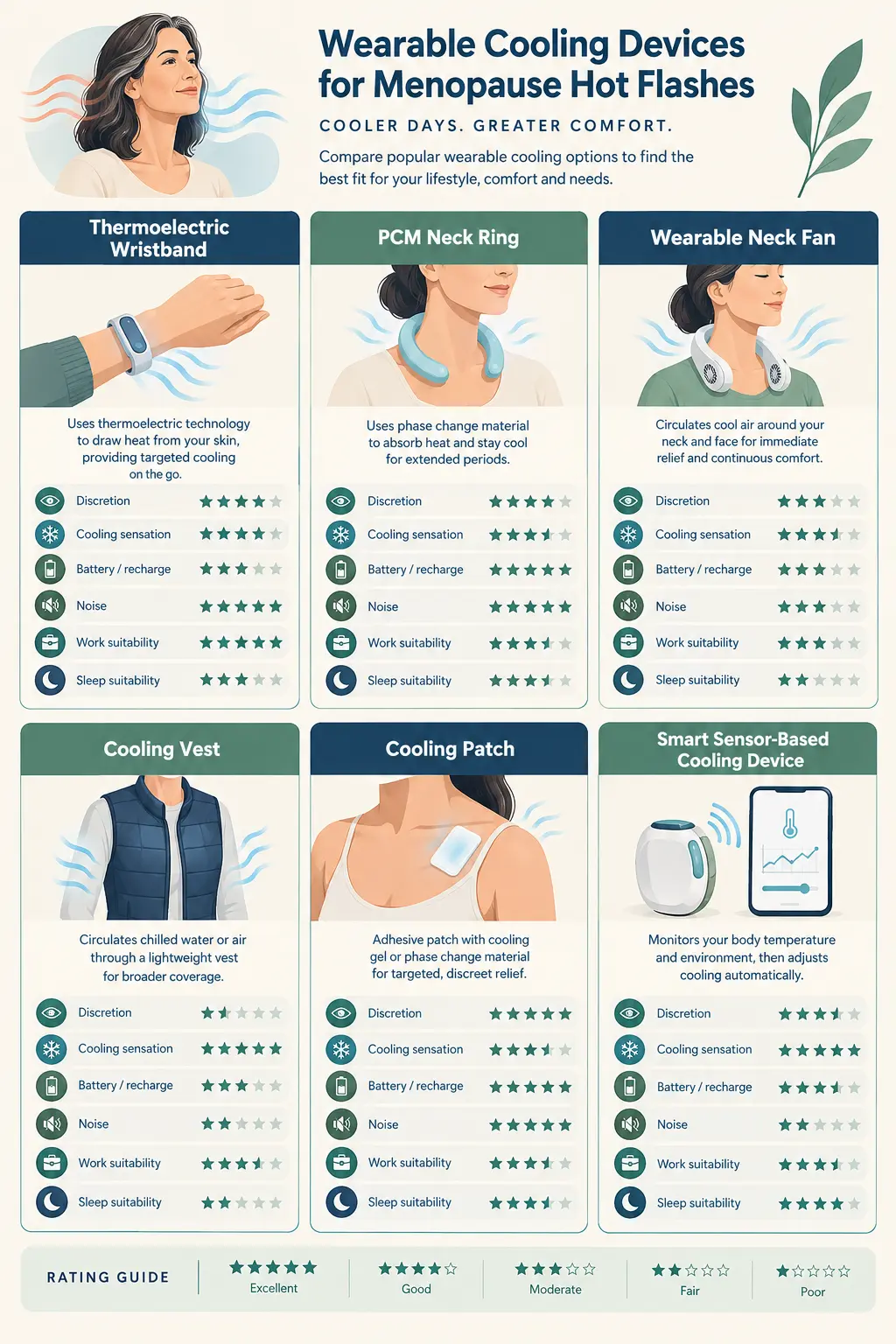
| Wearable type | Cooling method | Best for | Noise | Visibility | Main limitation |
|---|---|---|---|---|---|
| Thermoelectric wristband | Controlled warming/cooling sensation | Meetings, work, travel | Silent | Very low | Higher price |
| PCM neck ring | Phase-change cooling | Commutes, office breaks, travel | Silent | Medium | Cooling duration varies |
| Wearable neck fan | Airflow | Outdoor heat, errands, commuting | Low to medium | Medium | Can be noisy or visible |
| Cooling vest | PCM or cooling inserts | Uniforms, outdoor work, long shifts | Silent | Low under layers | Can feel bulky |
| Cooling patch | Cooling gel or phase-change material | Short, low-profile use | Silent | Very low | Shorter effect |
| Smart cooling system | Sensors plus cooling trigger | Tracking-focused users | Varies | Low to medium | Higher cost, limited evidence |
How Wearable Cooling Devices Work
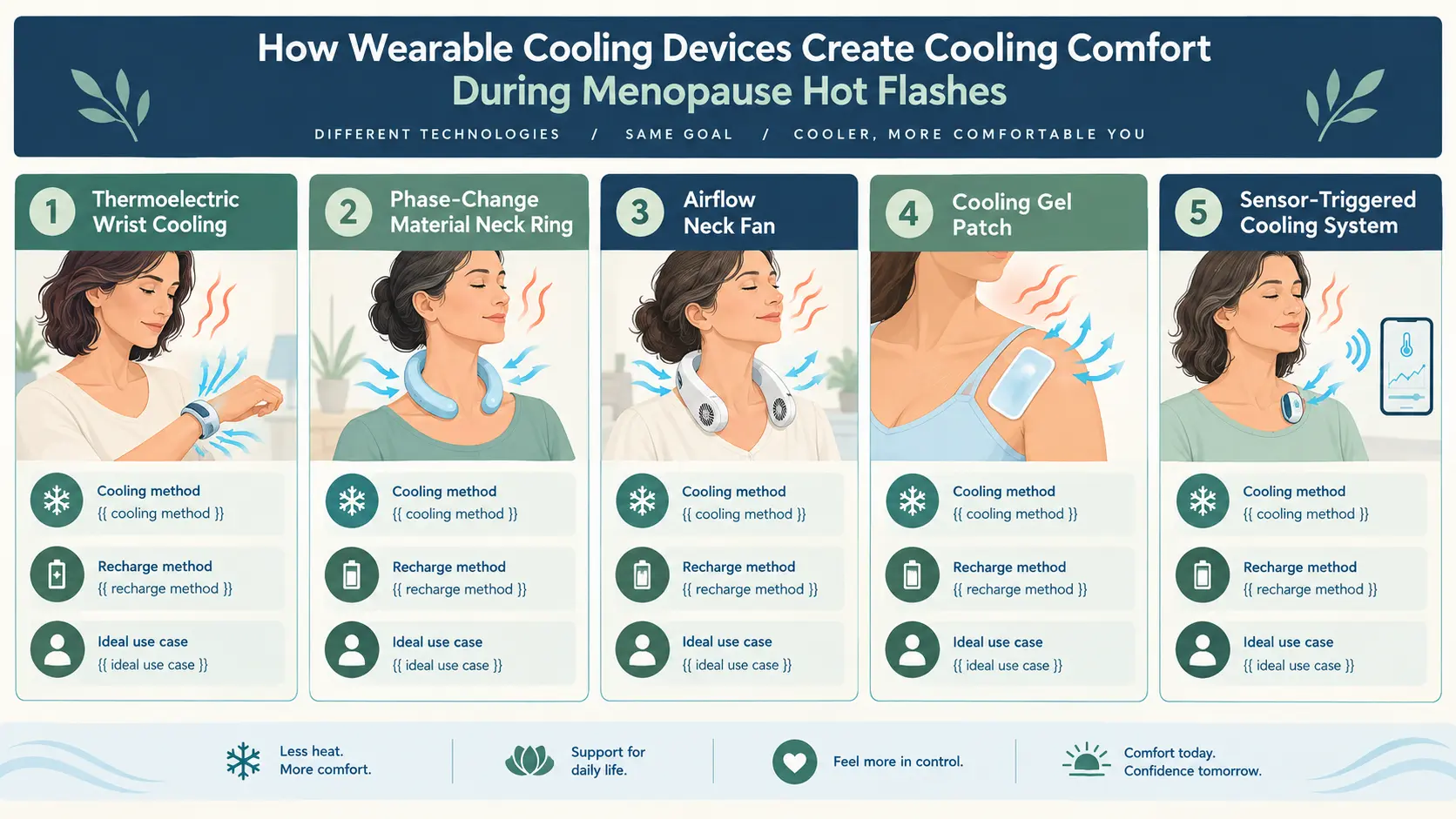
You do not need an engineering degree to shop smart. Most menopause cooling technology falls into a handful of families, and knowing which one you are buying tells you what to expect: how long it lasts, how loud it is, and whether it needs a charger.
Thermoelectric Wrist Cooling
These devices use a controlled temperature surface against the inside of your wrist to create a cooling (or warming) sensation. You press a button, and the surface changes temperature. The wrist is rich in blood vessels close to the skin, which is one reason this spot is popular. The result is a localized sensation of cool, not a whole-body chill.
Phase-Change Material Cooling
PCM materials absorb heat as they shift from solid to liquid, holding a steady cool temperature for a while. Once the material has melted, you recharge it by chilling it again, usually in a fridge or a cool spot. No battery, no noise. How long the cooling lasts varies by product and room temperature.
Airflow-Based Wearables
Neck fans, collar fans, and clip-on fans move air across your skin. They run on rechargeable batteries and offer dry cooling: no ice, no condensation. If moving air is what calms you down, this category is worth a look.
Cooling Gels and Patches
Gel patches and pads stick to or rest on the skin and give a short burst of cool sensation. They are handy for a quick fix, but the effect is brief. Adhesives can bother sensitive skin, so check materials and test a small area first.
Sensor-Based and App-Connected Systems
Some newer devices try to detect temperature shifts and trigger cooling, or connect to an app for tracking and controls. Wearable cooling products may use user-controlled, airflow, phase-change, or sensor-based technology, but the quality and evidence base vary significantly by device. If an app collects your health data, read the privacy policy before you sync anything.
What the Research Says About Wearable Cooling for Hot Flashes
Marketing pages love confident language. Research is usually quieter. Here is where things stand, in plain terms.
Evidence for Wrist Cooling
Some studies of wrist-based devices are promising. Participants have reported feeling more comfortable and less bothered by hot flashes. But results are device-specific, and more independent research is needed before anyone can say these findings apply to every wristband on the market.
What Device Studies Cannot Prove Yet
Be gentle with yourself as a shopper: the science here is young. Common limits include:
- Measuring comfort and hot-flash perception, which are subjective
- Unclear effects on sleep interference
- Placebo effects, which are real in symptom studies
- Small sample sizes and short study duration
- Brand-funded research, which deserves a closer read
Comfort Support vs Medical Treatment
If a cooling wearable helps you feel more comfortable during a hot flash, that matters. Comfort is not a small thing. But it is different from treatment. Wearables do not replace medical management, and they are not a substitute for talking with a clinician about menopause treatment alternatives that fit your health history.
Be Careful With Marketing Language
Look twice at phrases like "clinically proven," "stops hot flashes," "predicts hot flashes," or "rebalances hormones." Ask what the study actually measured and how many people were in it. A 2024 Consumer Reports review found limited placebo-controlled evidence for some thermal wrist devices, while a small 2025 study of a specific wrist-cooling device reported reduced severe hot-flash episodes but had a limited participant count. Encouraging, yes. Settled, no.
Cooling Wristbands for Menopause Hot Flashes
Wrist cooling is one of the central categories here for a simple reason: it is the one you can wear to a board meeting and nobody blinks.
Why Wristbands Are Popular
- Quiet operation
- A smartwatch-like look that blends in
- Hands-free use and quick activation
- Easy to carry and easy to hide under a sleeve
Features to Compare
Look at cooling and warming modes, battery life and charge time, weight, band fit, app controls, durability, and warranty. A band that pinches after an hour will end up in a drawer, so comfort counts as much as specs.
Best Use Cases
Meetings, presentations, commuting, business travel, restaurants, conferences, appointments, and formal events. Basically anywhere you want relief without a production.
Wristband Limitations
Price tends to run higher than passive options. Response is individual: some women feel a lot, others little. You will need to charge it, and if you already wear a smartwatch, a second wrist device can feel like too much. Cooling is also localized, not whole-body.
PCM Neck Rings and Cooling Scarves
If you want something simple, dry, and silent, this is your corner of the market.
Why PCM Neck Cooling Appeals to Hot Flash Shoppers
Dry cooling, so no dripping. Hands-free. No fan noise. Recharge by chilling it. It is portable and lower-tech than a wrist device, which some of us find refreshing.
What to Check Before Buying
- Weight and stiffness (a heavy ring gets old fast)
- Cooling duration and recharge method
- Condensation risk and material safety
- Fit, skin sensitivity, and how it sits with your collar
Best Use Cases
Commuting, walks, travel, breaks, office use, outdoor events, and warm bedrooms before sleep.
When a Neck Ring May Feel Too Visible
Professional dress codes, formal events, longer hair, and sensitive necks can make a ring feel like a lot. A cooling scarf or a wristband may be a gentler fit.
Wearable Neck Fans and Airflow Devices
Some of us do not want something cold pressed against the skin. We want a breeze. Wearable fans deliver it.
How Neck Fans Work
A battery-powered fan sits around the neck and sends air upward or forward through outlets. It is dry cooling with directional airflow, and it needs recharging like any battery device.
What Matters Most
Noise level, airflow strength, hair-catching risk, battery duration, weight, neck comfort, and charging. If you are noise-sensitive, look for reviews that mention volume specifically.
Best Use Cases
Commuting, outdoor work, errands, travel, casual offices, gym sessions, and warm rooms.
When to Choose a Wristband Instead
Formal meetings, quiet offices, video calls, customer-facing work, and anywhere a soft hum or a visible device would pull attention.
Cooling Vests, Patches, and Clothing-Based Wearables
Not every hot flash strategy has to be a gadget. These options widen your choices, especially if your job has a dress code or your heat lasts all day.
Under-Clothing Cooling Vests
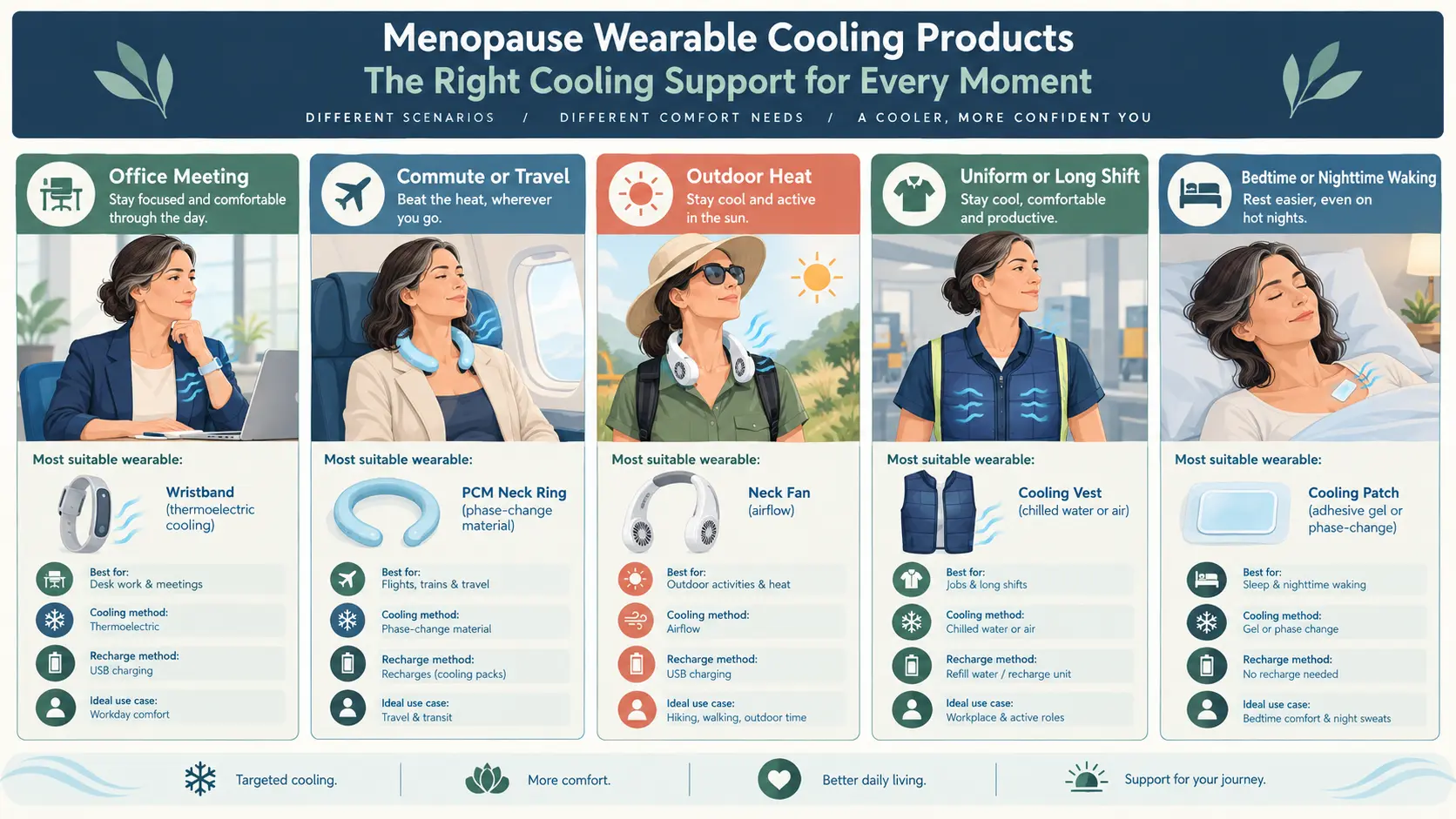
PCM vests and cooling inserts sit under your clothes. They can suit work uniforms, outdoor shifts, and professional outfits. Check coverage area and bulk, since a vest that shows through a blouse defeats the purpose.
Cooling Patches
Patches give short-term skin cooling in a low-profile form. Consider adhesive strength, placement, scent, skin sensitivity, and the fact that the cooling does not last long.
Cooling Clothing and Base Layers
Moisture-wicking tops, breathable fabrics, cooling undershirts, and light cardigans make layering easy when your temperature swings. Sometimes the best "device" is a good base layer you can peel off.
Best for Uniforms and Long Shifts
Nursing, hospitality, retail, education, warehouse, and outdoor work often come with dress-code limits and no chance to step away. Vests and base layers are built for exactly that.
How to Choose the Best Wearable Cooling Device
Picking one does not have to feel like a research project. Start with your hardest moment, the one where you wish you had something on hand, and work backward.
Decide How Discreet It Needs to Be
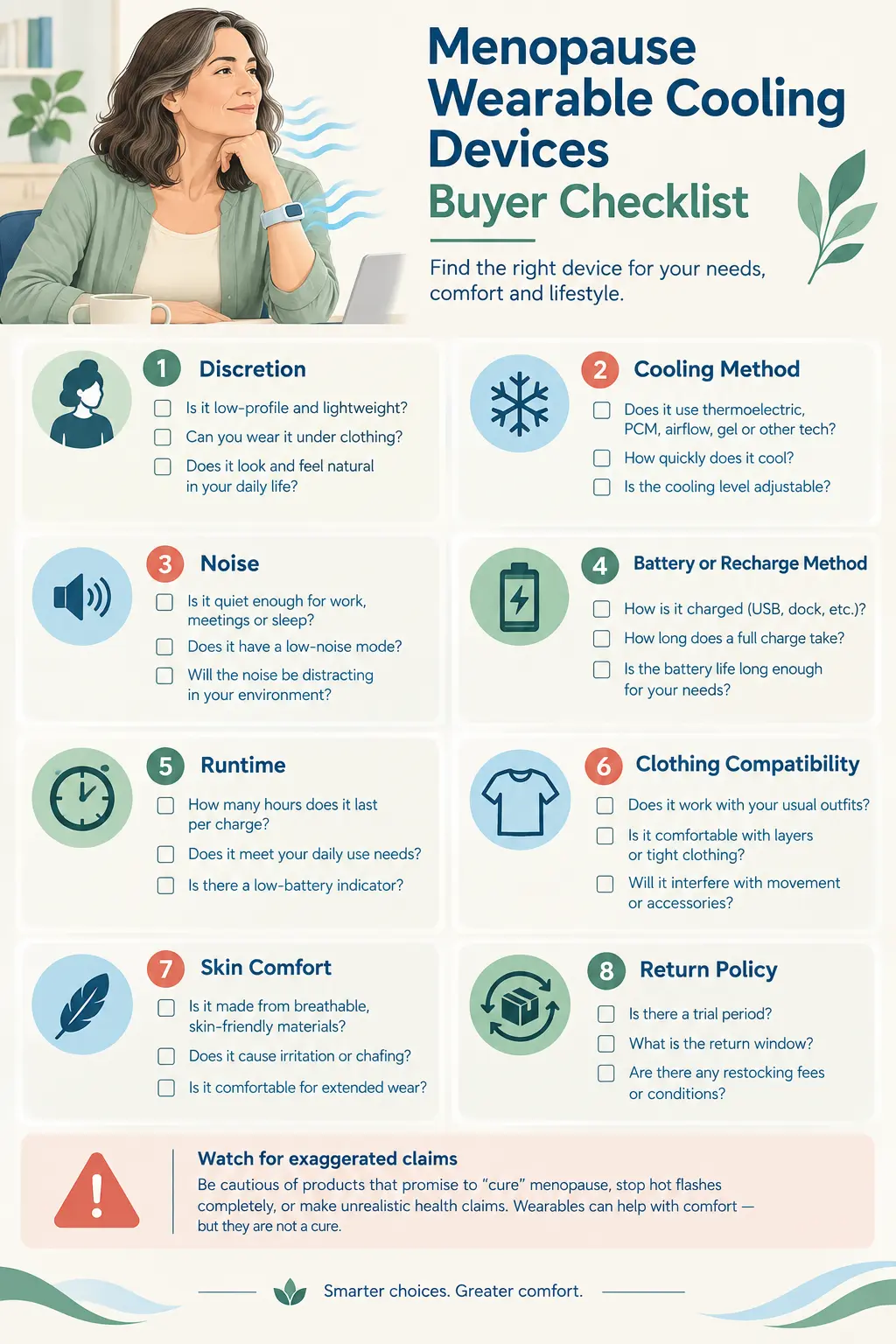
A wristband slips under a sleeve. A neck device is more visible. Fans make noise. Vests hide under layers. Match the device to your workplace expectations and your own comfort with being noticed.
Check Battery, Recharge, and Runtime
Look at USB charging, battery capacity, charge time, and actual runtime. For PCM, check the recharge method. If you travel, ask whether spare batteries or a quick top-up make sense.
Choose Between Contact Cooling and Airflow
Do you want a cool surface on your wrist or neck, or moving air? There is no right answer, only preference. If you dislike cold against your skin, try airflow. If you dislike wind or noise, try contact cooling.
Consider Clothing and Skin Sensitivity
Think about weight, straps, materials, metal sensitivity, adhesives, hair, jewelry, collars, and uniforms. Comfort you forget about is comfort you will actually use.
Review Return Policy and Warranty
Look for a trial period, hygiene-related return limits, battery warranty, replacement terms, customer support, and repair options. A generous return policy is a small act of respect from a brand.
Avoid Miracle Claims
Be skeptical of any product that says it "stops hot flashes permanently," "balances hormones," or replaces medical treatment. Those promises are a red flag, not a selling point.
Wearable Cooling Device vs Other Hot Flash Products
Wearables are one piece of a bigger cooling picture. Here is how they stack up against other common tools.
Wearable Cooling Device vs Desk Fan
A wearable moves with you and stays discreet. A desk fan delivers stronger airflow, but only where it sits. Many women use both.
Wearable Cooling Device vs Neck Wrap
Active cooling devices (like wristbands) need charging and cost more. Passive PCM or gel wraps are cheaper and silent but can be more visible and fade as they warm up.
Wearable Cooling Device vs Bed Fan
Wearables suit daytime and travel. A bed fan pushes air under the sheets, which is where night heat often builds.
Wearable Cooling Device vs Cooling Mattress Pad
A wearable offers portable, in-the-moment comfort. A cooling mattress pad works on the whole bed, which can matter more for night sweats.
Build a Full Menopause Cooling Toolkit
- Work: wristband, small fan, water bottle
- Travel: neck ring, compact fan, wipes
- Sleep: cooling pillow, bed fan, breathable sheets
- Outdoor use: cooling vest, neck fan, sun protection
How to Use a Wearable Cooling Device Safely
Most of this is common sense, but it is worth saying out loud.
Follow Product Charging and Care Instructions
Use the approved charger, keep batteries dry, inspect cables, and stop using a device that looks damaged.
Protect Sensitive Skin
Use short sessions if your skin reacts, avoid broken or irritated skin, put a fabric layer between skin and cold-contact devices, and stop if irritation appears.
Do Not Use Extreme Cold for Long Periods
Very cold surfaces held against skin for too long can cause discomfort and, in some cases, cold injury. Follow the product's instructions and listen to your body.
Cooling Is a Comfort Strategy
Wearables may help you feel more comfortable. They are not a replacement for individualized menopause care.
When to Seek Medical Advice
Talk to a healthcare provider about severe symptoms, sudden changes, chest pain, fainting, fever, unexplained sweats, medication concerns, or significant sleep disruption. You do not have to tough it out.
Frequently Asked Questions
Your comparison tool
Print it, fill it in, and decide with a clear head.
Get the Menopause Wearable Cooling Device Comparison Checklist →Final Takeaway
The best wearable cooling device for menopause hot flashes is the one that fits where you need it most. Wristbands for quiet, discreet work use. PCM neck rings for simple dry cooling. Neck fans for airflow. Cooling vests for longer shifts or uniforms.
You are not being dramatic, and you are not alone. Hot flashes are a real part of a real transition, and wanting to feel comfortable in your own skin is reasonable. Use the checklist, pick one device for your main situation (work, travel, outdoors, or sleep), and pair it with breathable layers, hydration, and other evidence-aware menopause support. And if symptoms feel like too much, please bring them to a healthcare provider. You deserve real support.